
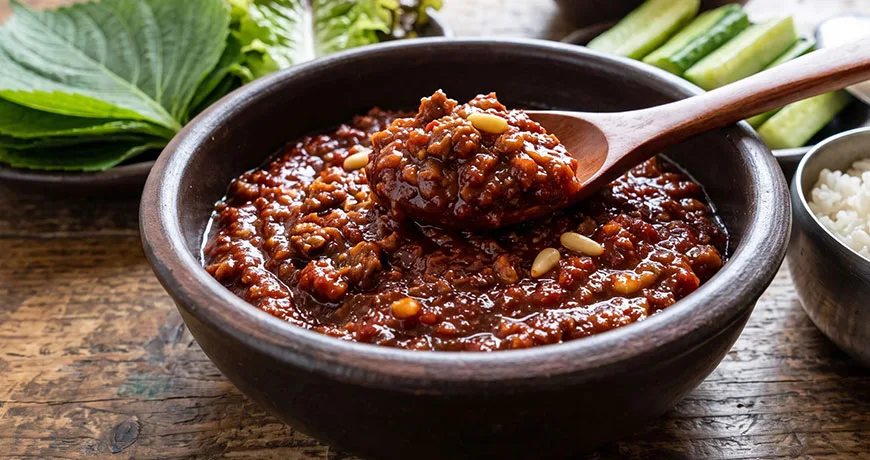
Bokkeumgochujang is a premium Korean pantry staple that elevates traditional red chili paste by incorporating minced beef, sesame oil, garlic, and natural sweeteners, then simmering them over low to medium heat to drive off moisture and maximize the Maillard reaction. The grain starches and amino acids within the Gochujang undergo caramelization while fusing seamlessly with the savory peptides of the minced meat, locking everything inside a stable lipid emulsion. It delivers the ultimate culinary payoff when smeared over warm rice or used as a rich vegetable dip.
- ⏱️ Total: 30–45 mins | Prep: 10 mins (Mincing and weighing ingredients) | Cook: 20–35 mins (Low-heat dehydration and Maillard simmering)
- 🍳 Difficulty: Medium (Requires vigilant heat control to prevent scorching high-sugar, high-viscosity paste)
- 🌶️ Profile: Deep, savory meat umami entwined with a sweet, nutty finish underneath a robust spicy punch
- 🍚 Focus: Meat Dehydration, Maillard Browning, Lipid Emulsion Coating
- 🍶 Pairing: Steaming white rice, steamed cabbage/pumpkin leaf wraps, and the ultimate Bibimbap base matrix
Physicochemical & Sensory Matrix
- Baseline Salinity: 6.0% ~ 8.0% (Diluted to a stable salinity balance by added meats, sweeteners, and oils)
- pH Equilibrium: 5.0 ~ 5.4 (Mildly acidic buffer derived from fermented Gochujang and caramelization processes)
- Viscosity Index: [■■■■□] (High-viscosity glossy paste bound by reduced moisture and oil-coating)
- Umami Density (T1R1/T1R3 Synergy): 9.5 / 10 (Powerful cross-synergy between Gochujang amino acids and beef protein glutamates)
- Shelf Stability: 30 ~ 60+ Days (Ambient or refrigerated stability achieved via lowered water activity and oil sealing)
- Aroma Profile: Caramelized Maillard Notes | Toasted Sesame Smoke | Heavy Capsaicin Spice
Ingredients (Yields 1 Medium Airtight Container)
- Primary Fermented Paste Matrix: 500g Traditional Gochujang (High Sun-dried red chili content)
- Animal Protein Matrix: 150g Minced Beef (Rump or brisket, completely purged of excess moisture using paper towels)
- Aroma & Moisture Control Matrix: 100g Finely Minced Onion, 50g Finely Minced Scallion, 2 tbsp Minced Garlic
- Lipid & Sweetener Matrix: 3 tbsp Sesame Oil, 1 tbsp Cooking Oil, 3 tbsp Jochung (Traditional Rice Syrup) or Maltose Syrup, 2 tbsp Cooking Wine
- Finishing Catalyst: 2 tbsp Ground Roasted Sesame Seeds, a pinch of Black Pepper
Allergy Information
- Contains: Soy, Wheat (Naturally present in traditional Gochujang grain components)
Equipment Deep Heavy-Bottomed Skillet or Wok, Silicone Spatula, Airtight Storage Container
Cooking Instructions
- Meat Dehydration & Maillard Seeding: Heat cooking oil in the skillet and add the minced beef, cooking wine, and black pepper. Sauté over medium heat until all the meat juices evaporate entirely and the surface browns into a crisp, savory crust.
- Aromatic Vegetable Extraction: Into the rendered beef fat, add the minced garlic, onion, and scallion. Sauté until the vegetable moisture releases and evaporates, allowing their natural sweetness and aromatics to fuse into the oil matrix.
- Paste Integration & Low-Heat Caramelization: Reduce the heat to low. Add the Gochujang and rice syrup (Jochung). Stir continuously with a silicone spatula to prevent scorching, simmering gently for 10 to 15 minutes.
- Lipid Emulsion Coating & Viscosity Setting: Once the raw Gochujang bite dissipates, revealing a glossy, deep brown sheen, stir in the sesame oil and ground roasted sesame seeds. Mix thoroughly and turn off the heat.
- Thermal Stabilization & Storage: Allow the Bokkeumgochujang to cool completely at room temperature. Pack it tightly into a sanitized airtight container, smoothing the top surface to block ambient air exposure, and store in the refrigerator for long-term safe consumption.
💡 Professional Culinary Tips
- The Science of Heat Control: Because Gochujang contains massive amounts of natural sugars and starches, high-heat cooking will instantly scorch the paste, producing acrid acrylamide bitterness. Maintaining medium-low heat while continuously scraping the bottom of the pan is an immutable law of this recipe.
- Lowering Water Activity: Failing to thoroughly dehydrate the meat and onions will dramatically compromise shelf life. Driving off all excess moisture during the simmering phase to create a tight oil-paste matrix is what generates natural preservation properties.
- Lipid Emulsion and Sealing Effect: The sesame oil and sugars from the jochung incorporated during the finishing stage bind into a high-molecular matrix during cooling, forming a delicate oil-sealing layer across the paste surface. This blocks external atmospheric contact and oxidation, fundamentally preventing flavor degradation during room-temperature or refrigerated storage.
🍶 Gastronomic Pairing
- Rice and Ssam Harmony: Bokkeumgochujang shines brightest when scooped generously over piping-hot white rice with a drop of sesame oil for an instantaneous, direct umami explosion. Additionally, spreading it across steamed cabbage or leafy green wraps stuffed with rice creates an elite textural and flavor balance against rich animal fats and fresh vegetable water content.
Nutrition Facts (Estimated)
Total Content : Approx. 20g (1 tbsp)
Calories : 50 kcal (High-protein meat and fermented carbohydrate matrix)
– Sodium : 380mg (Optimized salinity benchmarked to Gochujang base)
– Total Carbohydrate : 6.5g (Natural sugars and grain starches)
– Sugar : 3.2g (Rice syrup and fermented reducing sugars)
– Total Fat : 2.0g (Unsaturated and saturated fatty acids from sesame oil and beef)
– Saturated Fat : 0.5g
– Cholesterol : 5.0mg (Derived from minced beef)
– Protein : 2.0g (Beef and soybean structural protein matrix)
– Dietary Fiber : 0.8g
*Daily Values are based on a 2,000 calorie diet and standard Korean nutritional reference values.
**Nutritional values are calculated based on original ingredients; substitutions may alter specific macronutrients.
Origins and Food Culture of Stir-fried Red Chili Paste (Bokkeumgochujang)
1. Historical Lineage: Scholar Travel Rations and Noble Household “Portable Ssamjang”
- Historically, Bokkeumgochujang originated as an essential portable provision (haengrang-banchan) packed inside traveler bundles (gwanari-bottim) by noble yangban households and scholarly candidates journeying across mountain passes to sit for imperial civil service examinations in Hanyang (Seoul).
- Because raw gochujang lacked refrigeration and spoiled rapidly during extended summer journeys, clever domestic cooks devised a preservation method: sautéing minced meat, vegetable aromatics, and honey directly into the chili paste until all excess moisture evaporated. This advanced dehydration and oil-coating technique created a stable, nutrient-dense condiment that transformed simple wayside rice into a nourishing feast.
2. The Culinary Science of Moisture Evacuation, Water Activity Control, and Lipid Coating
- The technical mastery of authentic Bokkeumgochujang hinges upon precise thermal dehydration and lipid barrier management (water activity control).
- Sautéing minced proteins and aromatics in oil before folding in the chili paste allows cooks to drive moisture levels below 10%. As simmering continues, cooking lipids and meat fats envelop the fine gochujang particles in a stable, hydrophobic micro-emulsion. This protective barrier arrests ambient moisture migration and prevents microbial proliferation, allowing the paste to be stored safely at ambient temperatures for months without refrigeration.
3. The Modern Evolution into Global Tube Gochujang and K-Food Stardom
- Evolving from ancient scholarly travel rations into modern convenience, Bokkeumgochujang laid the conceptual foundation for the globally celebrated “tube-packaged stir-fried gochujang” carried by international travelers and K-food enthusiasts worldwide.
- Delivering instant umami and fiery comfort whenever squeezed over rice, it stands as an immortal monument to Korean domestic ingenuity, preservation science, and heartfelt hospitality.
The Savory Rendered Juices of Minced Beef and the Nutty Warmth of Sesame Oil Fusing Directly with the Thick, Sweet-Spicy Glaze of Aged Red Chili Paste: A Refined Portrait of Bokkeumgochujang
Bokkeumgochujang (Stir-fried Red Chili Paste, also known as Yak-gochujang) stands as the most practical yet luxurious seasoned paste in Korean gastronomy. Centered upon aged traditional red chili paste (gochujang) sautéed alongside finely minced beef or pork, sesame oil, honey or sugar, garlic, and scallions inside a heavy iron skillet, this masterclass in thermal reduction drives off excess moisture while concentrating umami to its absolute limits. While raw gochujang carries a sharp, youthful kick and a rustic fermented bean funk, Bokkeumgochujang undergoes a dramatic culinary metamorphosis as animal lipids and proteins merge with the starches and sugars of the paste under sustained heat. The process begins by searing minced beef in sesame oil to trigger rich Maillard browning, followed by the introduction of gochujang, honey, and garlic, reducing the mixture over low flame with constant stirring. This thermal dehydration encapsulates the capsaicinoids within a protective lipid matrix while lowering the overall water activity (Aw), yielding a shelf-stable condiment rich in body and profound savory depth that historically required no refrigeration.
Scooping a dollop of dense, glossy crimson paste from a small ceramic pot reveals an immediate, commanding aromatic profile: the nutty aroma of sesame oil and the rich, roasted perfume of seared beef mingling seamlessly with the caramelized, fermented bouquet of cooked chili paste. Resting a taste upon the tongue delivers an immediate rheological revelation: the high-viscosity paste coats oral tissues with the weight of velvet, introducing an elegant wave of honeyed sweetness balanced by clean mineral salinity. As the minced meat particles yield between the teeth, they release concentrated savory juices that combine with the deep amino-acid umami of the gochujang base. Spooned generously over steaming white rice or wrapped inside crisp lettuce leaves, Bokkeumgochujang elevates simple pantry staples into a complete, deeply satisfying meal without the need for elaborate side dishes.
The cultural identity of Bokkeumgochujang lies in its historical role as the ultimate portable umami archive—serving elite royal travelers, scholarly travelers facing long journeys, and soldiers marching off to distant posts. By tempering the raw aggression of chili paste with rich animal fats and sweet honey to create an all-purpose companion for plain rice, a pot of stir-fried chili paste remains an enduring monument of preservation science, culinary ingenuity, and brilliant Korean craftsmanship.
Editor’s Review
1. A Three-Tiered Structural Dynamics of Velvety Paste Coating, Chewy Meat Granule Mastication, and Silky Lipid Lubrication
Bokkeumgochujang transcends standard liquid sauces or raw pastes by delivering a high-density, multi-phase colloidal texture. Prolonged pan reduction condenses the dextrins and protein networks of the gochujang base, offering firm plastic resistance on a spoon while melting smoothly across oral tissues upon ingestion. Within this smooth, continuous matrix, finely minced and seared beef particles supply active masticatory feedback, yielding rich meaty notes that ensure an engaging, non-fatiguing mouthfeel from the first bite to the last.
2. Maillard Protein-Sugar Reactions, Lipophilic Capsaicin Emulsification, and Water Activity (Aw) Suppression
The structural and flavor stability of Bokkeumgochujang is governed by high-temperature lipid interactions and moisture-barrier physics:
- Maillard Flavor Amplification: Simultaneous searing of minced meat and chili paste under elevated heat (140-160°C) accelerates non-enzymatic browning between amino acids and reducing sugars, generating abundant alkylpyrazines and furans that impart a deeply roasted bouquet.
- Lipid Emulsification & Heat Softening: Rendered animal fats and sesame oils physically solubilize the lipophilic capsaicinoids, converting the sharp, needle-like burn of raw chili into a rounded, enveloping thermal warmth.
- Water Activity (Aw) Reduction: Extended thermal evaporation combined with the humectant properties of honey and sugar drives down water activity, establishing an effective osmotic barrier against microbial proliferation and securing long-term shelf stability at ambient temperatures.
3. The Sovereign Portable Umami Archive of Korean Gastronomy
Bridging the gap between raw fermentation and cooked protein convenience, Bokkeumgochujang stands as a masterwork of culinary preservation and flavor concentration. By transforming basic chili paste into a rich, travel-stable condiment capable of turning plain grains into a feast, this glossy crimson paste captures the enduring resourcefulness, preservation science, and brilliance of the traditional Korean kitchen.