
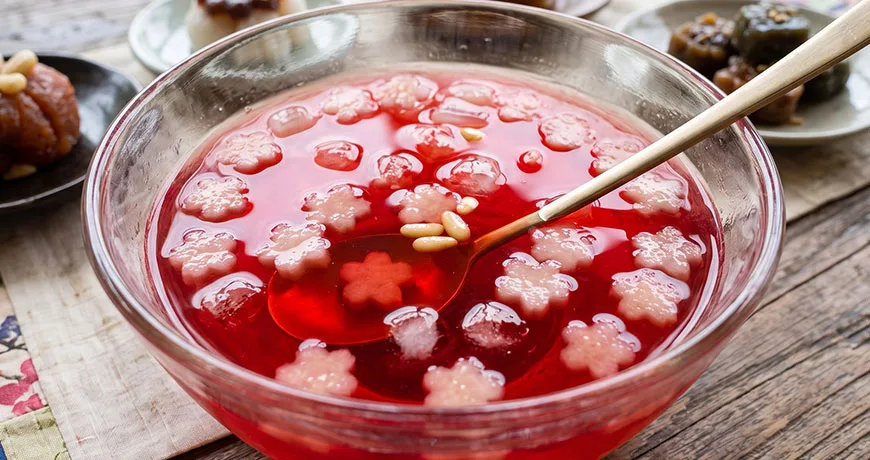
Omija-hwachae | Omija Punch | 오미자화채
A stunningly beautiful and deeply refreshing traditional Korean punch made by cold-steeping dried Omija (five-flavor berries). Named for its unique and complex flavor profile—sweet, sour, bitter, salty, and spicy—the vibrantly red, tart liquid is perfectly balanced with a generous amount of sweet honey. Delicately garnished with flower-shaped pear slices and floating pine nuts, it is a visually captivating and cooling dessert, making it the perfect thirst quencher for a hot summer day.
⏱️ Total: 12 hrs 30 mins (incl. steeping) | Prep: 20 mins | Cook: 10 mins | 🍳 Easy | 🌺 Tart, Sweet & Refreshing | 🥤 Stunning Traditional Dessert
Ingredients (Yields approx. 15 servings)
- Main Ingredients: 1 cup dried Omija (Schisandra berries / five-flavor berries), 15 cups water (4 cups for steeping + 11 cups for adjusting), 1 Korean pear (Bae)
- Sweetener & Garnish: Honey to taste, a small handful of pine nuts
💡 Substitutes & Notes
- Korean pear ➔ Asian pear or Bosc pear (any crisp, sweet pear holds up well).
- Honey ➔ Agave nectar, maple syrup, or simple syrup for a fully vegan option.
Allergy Information
- Contains: Pine nuts
- Warning: If using honey, do not serve to infants under 1 year old due to the risk of botulism. (Fully Vegan & Vegetarian-friendly if using sugar/syrup)
Equipment
- Large Glass or Ceramic Bowl, Fine-mesh Strainer and Cheesecloth, Small Flower-shaped Cookie Cutter, Knife, Cutting Board
Cooking Instructions
- Steeping the Omija: Gently wash the dried Omija under cold running water to remove any dust, then drain well. Place the berries in a large glass or ceramic bowl and pour in 4 cups of cold water. Let it cold-steep overnight (about 10–12 hours) to gently extract its brilliant ruby color and complex flavors.
- Making the Punch Base: Carefully strain the infused Omija liquid through a cheesecloth to ensure a clean, clear broth. To prevent the sourness from being too overpowering, gradually add the remaining 11 cups of water to adjust the concentration to your liking. Stir in honey generously to balance the tartness with sweetness.
- Cutting the Pear Flowers: Peel the Korean pear and slice it very thinly, about 1mm thick. Using a small flower-shaped cookie cutter, punch out beautiful little pear flowers.
- Prepping the Pine Nuts: Pick out plump, glossy pine nuts and carefully snap off the tiny, dark tips (the “eyes”) for a clean and elegant presentation.
- Garnishing & Serving: Ladle the vibrant red punch into serving bowls. Generously float the pear flowers and delicately place a few pine nuts on top.
💡 Cooking & Pairing Tips / Health Benefits
- Cold Steeping is Crucial: It is highly recommended to gently cold-steep Omija overnight. If you boil the berries in hot water, they will release an unpleasantly strong bitter and astringent taste that ruins the refreshing profile of the punch.
- Mind Your Bowl: Because of the natural acidity of the berries, it is best to use a glass or ceramic bowl rather than metal when steeping, as metal can cause an unwanted chemical reaction and metallic taste.
- The Ultimate Summer Refresher: For the best experience, keep the Omija broth and pear slices in the fridge and mix them right before serving! Dropping in a few ice cubes makes it a fantastic, cooling treat for a hot day.
Nutrition Facts (Estimated)
Total Content : Approx. 250ml (1 serving, incl. pear garnish)
Calories : 70 kcal
– Sodium : 2mg
– Total Carbohydrate : 18.0g
– Sugar : 15.0g
– Total Fat : 0.5g
– Saturated Fat : 0.0g
– Cholesterol : 0.0mg
– Protein : 0.2g
– Calcium : 10.0mg
*Daily Values are based on a 2,000 calorie diet and standard Korean nutritional reference values
**Nutritional values are calculated based on the original ingredients, not substitutes
The Quintessence of Five Flavors: A Crimson Symphony of Schisandra and Blooming Pear
Omijahwachae (Schisandra Berry Punch with Pear) stands as the radiant zenith of traditional Korean royal court gastronomy (Eumcheongnyu), flawlessly harmonizing the five fundamental tastes of nature—sweetness, sourness, bitterness, saltiness, and pungency—across a luminous, ruby-red expanse. The ancestral wisdom of cold-infusing the dried berries in pristine spring water bypasses the harsh extraction of astringent seed tannins that heat would otherwise provoke, coaxing forth only delicate anthocyanin pigments and vibrant, refreshing fruit acids.
When the crimson brew is gently balanced with raw honey and sugar, and adorned with paper-thin Asian pear slices carved into blossoming flowers, the punch transcends mere refreshment to become a poetic visual and sensory masterpiece. The floating ivory pear blossom and fragrant pine nuts provide an exquisite structural balance, bridging the electric brightness of the first sip with a crisp, hydrating chew.
True gastronomy does not rely on superficial artifice; it thrives in the alchemy of understanding an ingredient’s intrinsic nature, transforming competing flavor profiles into sublime equilibrium. Partaking in a chilled bowl of Omijahwachae today is an exquisite purifying ritual—awakening sluggish senses and replenishing the spirit with pure, aristocratic vitality.
Editor’s Review
1. A Dynamic Cadence of Electric Five-Flavor Acidity and Crisp Pear Blossoms
The moment the frosty, jewel-like crimson nectar coats the palate, a brilliant burst of citric tartness and rounded fruit sweetness instantly shocks the sensory nerves, swiftly trailed by subtle bitter and saline undertones. Biting into the flower-shaped pear slice releases a deluge of cool, crisp juice, while the buttery pine nuts soften the berry’s razor-sharp acidity, orchestrating an endlessly refreshing, multi-dimensional sensory thrill.
2. Cold-Infusion Extraction Thermodynamics and Organic Acid–Anthocyanin Stability
Omijahwachae represents an exacting study in non-thermal botanical extraction. By utilizing cold maceration, the technique prevents the heat-induced leaching of bitter lignans and harsh polyphenols concentrated within the berry seeds. This preserves the delicate anthocyanin matrices responsible for the brew’s crystal-clear optical brilliance while selectively liberating high concentrations of malic and citric acids. The addition of simple sugars serves as a crucial thermodynamic buffer against the naturally low pH, while the porous, air-trapping cellular structure of the sliced Asian pear ensures its effortless buoyancy atop the punch.
3. The Aristocratic Elegance of the Royal Court and the Grounding Solace of Summer Serenity
Presented in polished porcelain with floating ice crystals during Joseon Dynasty royal banquets, a bowl of Omijahwachae embodies the pinnacle of thoughtful summer hospitality. Gazing upon the pure white pear blossom floating serenely over the ruby-red lake washes away the stifling heat and mental exhaustion of modern life, granting a timeless sanctuary of aristocratic grace, emotional rejuvenation, and lucid clarity.