
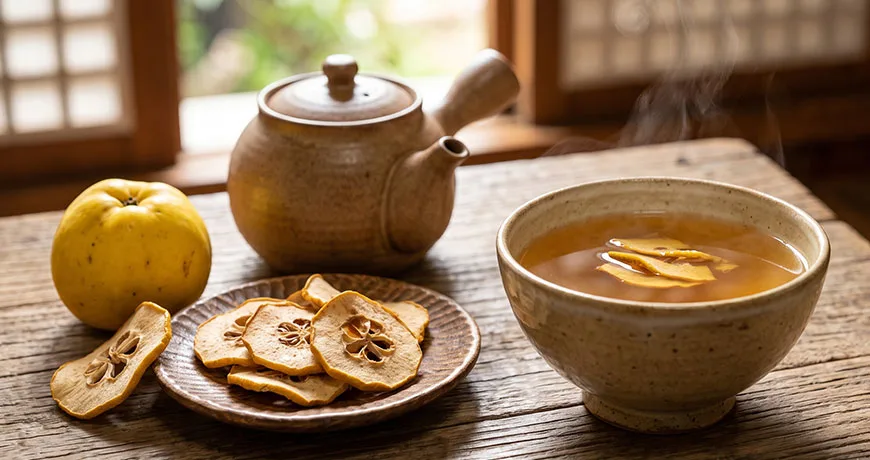
A highly fragrant and aromatic traditional Korean tea made by simmering thinly sliced, semi-dried Chinese quince (mogwa). Renowned for its captivating, perfume-like floral scent and a pleasant sweet-and-sour flavor, it is typically enjoyed warm with a touch of honey or sugar. It is a quintessential winter and transitional-season beverage in Korea, heavily praised for its natural ability to soothe sore throats and prevent colds when the chilly winds begin to blow.
⏱️ Total: 1 day 1 hr | Prep: 1 day (drying) | Cook: 1 hr | 🍳 Easy | ☕ Sweet, Sour & Aromatic | 🌿 Throat-Soothing Wellness Tea
Ingredients (3-4 servings)
- Main Ingredients: 30g semi-dried Chinese quince slices (approx. 1/2 fresh quince, mogwa), 1.5 liters water
- Optional Sweetener: Honey, sugar, or agave nectar to taste
💡 Substitutes & Notes
- Honey ➔ Agave nectar, maple syrup, or regular sugar for a fully vegan option.
Allergy Information
- Warning: If using honey, do not serve to infants under 1 year old due to the risk of botulism. (Fully Vegan & Vegetarian-friendly if using sugar/syrup or no sweetener)
Equipment
- Knife, Cutting Board, Drying Rack/Tray, Kettle or Medium Saucepan, Fine-mesh Strainer
Cooking Instructions
- Slicing & Drying: Wash the fresh quince thoroughly, halve it, and scoop out all the seeds. Slice the fruit thinly (about 2–3mm thick). Spread the slices out on a drying rack and let them air-dry in a well-ventilated area for about a day until they turn slightly leathery.
- Boiling: In a kettle or saucepan, combine the semi-dried quince slices and 1.5 liters of water. Bring to a rolling boil over high heat.
- Simmering (Steeping): Once boiling, reduce the heat to low. Let it simmer gently for 40 minutes to 1 hour to fully extract the vibrant sweet, tart flavor and fragrant essential oils from the fruit.
- Finishing & Serving: Turn off the heat and strain out the quince slices. Pour the warm, golden tea into cups and stir in honey or sugar to your liking. (You can also chill it and serve it over ice for a refreshing cold drink.)
💡 Cooking & Pairing Tips / Health Benefits
- Why Dry It?: While you can brew fresh quince, letting the slices air-dry for a day naturally reduces the fruit’s natural astringency and heavily concentrates its sweet and aromatic profile, resulting in a much deeper flavor.
- The “Ugly” Fruit with the Best Scent: Mogwa is notoriously tough, bumpy, and terribly astringent when raw, making it unsuitable for eating fresh. However, its unparalleled floral fragrance transforms into culinary magic when boiled or preserved in sugar.
- Throat & Lung Care: Packed with Vitamin C, saponins, and citric acid, this tea is Korea’s ultimate traditional home remedy for clearing phlegm, soothing severe coughs, and relieving fatigue during the winter months.
Nutrition Facts (Estimated)
Total Content : Approx. 250ml (1 serving, un-sweetened)
Calories : 20 kcal
– Sodium : 2mg
– Total Carbohydrate : 5.0g
– Sugar : 3.0g
– Total Fat : 0.0g
– Saturated Fat : 0.0g
– Cholesterol : 0.0mg
– Protein : 0.1g
– Calcium : 5.0mg
*Daily Values are based on a 2,000 calorie diet and standard Korean nutritional reference values
**Nutritional values are calculated based on the original ingredients, not substitutes
A Late-Autumn Lyricism Forged in Golden Fragrance and Gentle Warmth
Mogwacha (Chinese Quince Tea) is a brilliant lyricism of Korean traditional fruit tea gastronomy, where an unyielding, rock-hard fruit concealing celestial aromas inside a rugged golden skin transforms through drying and patient decoction into a radiant, translucent brew. Naturally too astringent and fibrous to be eaten raw, the Chinese quince is thinly sliced and sun-dried for a day to shed excess moisture, condensing its essential aromatic compounds and vibrant fruit acids into a denser sensory matrix.
Simmering gently inside a kettle over low heat, the resulting pale amber infusion fills the surrounding air with an intoxicating fruity bouquet long before it touches the cup. The initial sip delivers an uplifting, crisp acidity that awakens the palate, smoothly followed by a lingering floral sweetness that coats the throat and senses in comforting warmth. Balanced with a touch of honey or sugar, this sweet-and-sour harmony embodies the ancestral wisdom of seasonal nourishment, protecting the body as the seasons turn.
True gastronomy does not rely on superficial external beauty, but thrives in the alchemy of taming tough, unpolished ingredients into the purest and most aromatic nectar. Cupping a steaming bowl of Mogwacha with both hands today is a serene healing ritual—soothing raw breaths at the edge of colder days and infusing the soul with pristine, luminous warmth.
Editor’s Review
1. An Enchanting Sensory Cadence of Intoxicating Floral Aroma, Bright Acidity, and Honeyed Velvet
The moment the teacup nears the lips, the intense, perfume-like citrus-floral fragrance of the Chinese quince floods the senses with breathtaking elegance. Taking a sip releases a vibrant burst of natural malic and citric acids that pleasantly stimulates the palate, swiftly rounded out by the silky, viscous glide of honey. This interplay softens any sharp edges into an endlessly refreshing, multi-layered sweetness that lingers delicately on the finish.
2. Sclereid Relaxation Thermodynamics and Organic Acid–Tannin Extraction Mechanics
Mogwacha represents an exacting study in botanical extraction, structurally overcoming the dense, lignified stone cells (sclereids) characteristic of the fruit through controlled dehydration and aqueous heating. Preliminary air-drying evaporates surface water to lock in volatile aromatic esters. During gentle decoction, organic acids and water-soluble vitamins systematically leach into the solution without thermal degradation. Concurrently, astringent polyphenolic tannins form stable complexes with the added simple sugars (fructose and glucose), effectively buffering astringency and securing an optimal acid-to-sugar equilibrium.
3. Seasonal Respite for the Senses and the Grounding Solace of a Fragrant Hearth
Holding a steaming cup of Chinese quince tea as the crisp autumn wind sets in serves as an authentic emotional haven, soothing a tired throat and melting away physical fatigue. Revered for generations as a restorative herbal remedy to protect the respiratory system and comfort digestion, savoring this fragrant golden infusion clears away daily stress, granting a timeless sanctuary of stillness, emotional rejuvenation, and lucid vitality.