
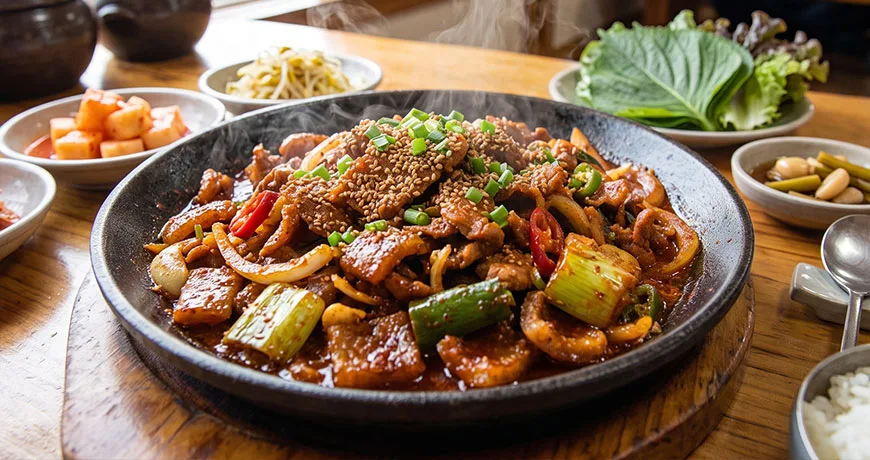
A beloved Korean street food and drinking snack (anju) specialty featuring pork rinds (dwaeji-kkeopdegi). The rinds are first parboiled with aromatics to remove any gamey odors, carefully trimmed of excess inner fat, scored, and then stir-fried over high heat with onions, scallions, and perilla leaves in a spicy, sweet, and garlicky gochujang glaze. Celebrated for its irresistibly gelatinous, springy, and chewy texture (jjolgit-jjolgit), it is traditionally served with a side of nutty roasted soybean powder (konggaru) to balance the fiery heat.
⏱️ Total: 35 mins | Prep: 20 mins (parboiling & slicing) | Cook: 15 mins | 🍳 Easy to Moderate | 🍺 Iconic Pojangmacha Anju | 🥢 Rich Collagen & Chewy Texture
Ingredients (2-3 servings)
- Main Ingredients: 400g pork rind (dwaeji-kkeopdegi, cleaned), 1/2 yellow onion (sliced), 1 stalk green onion (cut into 3–4 cm lengths), 1–2 Cheongyang green chili peppers (sliced), 6–8 fresh perilla leaves (kkaet-nip, roughly sliced), 1.5 tbsp cooking oil
- Parboiling Aromatics (Boiling Pot): 1 tbsp soybean paste (doenjang), 2 tbsp cooking wine (cheongju / mirin), 3–4 slices fresh ginger, 5 whole black peppercorns, 1/2 stalk green onion
- Spicy Glaze & Marinade: 2.5 tbsp Korean red pepper flakes (gochugaru), 1.5 tbsp gochujang (Korean chili paste), 2 tbsp soy sauce, 1.5 tbsp sugar, 1.5 tbsp rice syrup (mulyeot) or honey, 2 tbsp minced garlic, 1/2 tbsp finely grated ginger, 1 tbsp cooking wine, 1/4 tsp black pepper
- Finishing Touches & Dipping: 1 tbsp toasted sesame oil, 1 tsp toasted sesame seeds, 2 tbsp roasted soybean powder (konggaru, for dipping)
Allergy Information
- Contains: Pork, Soy (Gochujang, Soy sauce, Doenjang, Soybean powder), Wheat (Gochujang, Soy sauce, Doenjang), Sesame
Equipment
- Large Stockpot (for parboiling), Chef’s Knife, Cutting Board, Frying Pan or Wok, Kitchen Tongs, Spatula
Cooking Instructions
- Parboiling & Deodorizing: Place the pork rinds in a large pot filled with water. Add the parboiling aromatics (doenjang, cooking wine, ginger, scallion, and peppercorns). Bring to a boil over medium-high heat and simmer for 10–15 minutes until the skin turns pliable and slightly translucent.
- Trimming Subcutaneous Fat: Drain and rinse under cold water. Lay the pork rind flat with the inner side facing up. Use a sharp knife to scrape away the remaining white fat layer—this ensures a clean, non-greasy, and pleasantly chewy texture.
- Scoring & Cutting: Make shallow crisscross diagonal cuts across the outer skin side to allow better sauce absorption. Cut the rinds into bite-sized strips (approx. 1.5 cm x 4 cm).
- Mixing the Sauce: In a bowl, whisk together gochugaru, gochujang, soy sauce, sugar, rice syrup, minced garlic, grated ginger, cooking wine, and black pepper.
- High-Heat Stir-Frying: Heat cooking oil in a wide frying pan or wok over medium-high heat. Add the sliced pork rinds and stir-fry for 2–3 minutes until lightly blistered. Add the sliced onions and the spicy glaze, tossing continuously for 3–4 minutes until the sauce reduces into a glossy lacquer.
- Finishing & Serving: Toss in the sliced green onions, green chilies, and perilla leaves during the final minute of cooking. Turn off the heat, drizzle with toasted sesame oil, and sprinkle toasted sesame seeds.
- Dipping: Transfer to a hot platter and serve immediately alongside a small dish of roasted soybean powder (konggaru).
💡 Cooking & Pairing Tips / Health Benefits
- Scraping the Inner Fat Layer: The secret to restaurant-grade chewy pork rinds lies in thoroughly scraping away the inner white fat layer after boiling. This prevents the dish from turning soggy or heavy while maximizing its distinctive snappy bounce.
- Nutritional Characteristics: Pork rinds are naturally carbohydrate-free and rich in structural proteins (collagen/gelatin). Cooking them with antioxidant-rich garlic, onions, and perilla leaves aids digestion and adds vibrant herbal freshness to the rich texture.
- Roasted Soybean Powder Synergy (Konggaru): Dipping the hot, spicy pork rind into roasted soybean powder is an iconic pairing. The nutty, savory powder instantly mellows the sharp chili heat and coats each bite in a rich, comforting aroma.
- Perfect Food & Beverage Pairing: A legendary companion for chilled Korean soju, cold draft beer, or rustic rice wine (Makgeolli).
Nutrition Facts (Estimated)
- Total Content : Approx. 200g (1 serving)
- Calories : 345 kcal
– Sodium : 780mg
– Total Carbohydrate : 16.5g
– Sugar : 8.2g
– Total Fat : 16.8g
– Saturated Fat : 5.4g
– Cholesterol : 68.0mg
– Protein : 32.0g
– Calcium : 38.0mg
– Dietary Fiber : 2.5g
(Daily Values are based on a 2,000 calorie diet and standard Korean nutritional reference values)
The Triumph of Elastic Resilience: A Dynamic Harmony of Concentrated Collagen and Crimson Flame
Stir-fried pork rind is a brilliant paradox of Korean street gastronomy, where one of the most humble, elemental cuts transcends its unpolished origins through the transformative power of roaring flame. Stripping away heavy surface fats through a preliminary boiling stage, the dense block of pure collagen is immersed into a fiery, crimson glaze of chili paste and aromatics, awakening a rich, concentrated elasticity.
Sizzling in a piping-hot pan, the billowing smoky heat and the glossy, ruby-red sheen of the rind immediately captivate the senses. The moment the teeth press against its dense, chewy resistance, a supple bounce releases a clean, deeply savory finish—delivering an unmistakable tactile joy that no conventional cut of prime meat can replicate.
True gastronomy does not reside in lavish luxury, but in mastering the intrinsic physical texture of an ingredient to nourish both body and soul. Savoring this spicy, resilient plate tonight is a restorative evening ritual, fueling tired spirits with concentrated vitality and unpretentious warmth.
Editor’s Review
1. A Dynamic Interplay of Supple Chewy Tension, Fiery Chili Glaze, and Nutty Roasted Bean Powder
The moment a glistening piece of spicy pork rind hits the palate, its remarkably dense, springy chew delivers an immediate tactile thrill, releasing clean savory notes wrapped in the sharp heat of garlic and chili. Dipping each bite into fragrant roasted soybean powder introduces a mellow, nutty richness that tempers the spice, orchestrating a multi-layered sensory rhythm of pure gastronomic pleasure.
2. High-Molecular Collagen Hydrolysis and High-Heat Emulsion Mechanics
Dwaejikkeopdegibokkeum represents an exacting study in structural protein thermodynamics, where dense triple-helix collagen fibers are partially hydrolyzed into soluble gelatin during the primary boiling stage to transition toughness into supple elasticity. When flash-cooked over high heat, the leaching gelatin naturally emulsifies with the moisture and oils of the chili marinade, accelerating Maillard caramelization and creating a viscous, clinging glaze without artificial thickeners.
3. Unpretentious Solace and Cathartic Release Born in the Warmth of Nighttime Havens
Served piping hot amidst the clinking glasses and rising steam of a casual nighttime pub, a plate of spicy stir-fried pork rind serves as a comforting sanctuary against the fatigue of daily labor. Sharing these snappy, flavor-packed morsels over honest conversation washes away modern exhaustion, granting an authentic refuge of camaraderie, emotional recovery, and renewed vitality.