
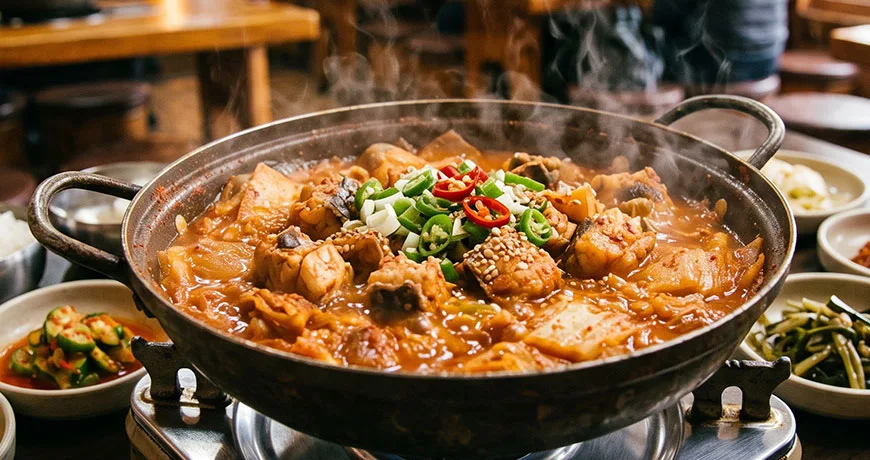
A celebrated winter delicacy from the coastal regions of Gangwon Province (such as Sokcho and Goseong), featuring the Pacific spiny lumpsucker (dochi). Though peculiar and plump in appearance, dochi is remarkably clean-tasting with zero fishy odor, velvety tender flesh, gelatinous collagen-rich skin, and soft edible cartilage bones. Cut into bite-sized chunks (often with its crunchy roe), it is stir-fried with well-fermented cabbage kimchi (sin-kimchi) and braised with garlic, chili flakes, and scallions until simmering in a slightly saucy, tangy, and deeply savory gravy (duruchigi style).
⏱️ Total: 30 mins | Prep: 15 mins (cleaning & scalding) | Cook: 15 mins | 🍳 Easy to Moderate | 🐟 East Sea Winter Specialty | 🌶️ Rich Collagen & Tangy Savory
Ingredients (2-3 servings)
- Main Ingredients: 1 whole fresh lumpsucker (dochi, approx. 500–600g with roe), 250g well-fermented sour cabbage kimchi (sin-kimchi, chopped), 1/2 yellow onion (sliced), 1 stalk green onion (cut into 3 cm lengths), 1–2 Cheongyang green chili peppers (sliced)
- Pre-Treatment / Scalding: Boiling water (to scald and remove mucus/slime from the skin)
- Seasoning & Braising Sauce: 2 tbsp Korean red pepper flakes (gochugaru), 1 tbsp gochujang (Korean chili paste), 1.5 tbsp Korean soup soy sauce (guk-ganjang or fish sauce), 1.5 tbsp minced garlic, 1 tbsp cooking wine (cheongju / mirin), 1 tsp sugar (to balance kimchi acidity), 1/4 tsp black pepper, 1 cup water or anchovy-kelp broth
- Finishing Touches: 1 tbsp toasted perilla oil (deulgireum) or sesame oil, 1 tsp toasted sesame seeds
Allergy Information
- Contains: Fish (Pacific Spiny Lumpsucker), Soy (Gochujang, Soy sauce), Wheat (Gochujang, Soy sauce), Sesame (Kimchi contains trace seafood/shrimp extract)
Equipment
- Large Stockpot / Kettle (for hot water blanching), Heavy Cast-Iron Pan or Wok, Kitchen Shears, Knife, Cutting Board, Ladle / Wooden Spoon
Cooking Instructions
- Scalding & Scraping the Skin: Pour boiling water quickly over the whole dochi in a sink or large bowl. The slippery surface slime will turn cloudy white. Gently scrape off the white film with a knife or your hands under running water, then rinse clean.
- Gutting & Slicing: Slit the belly open to separate the precious roe (dochi-al) and liver. Discard the bitter gall bladder and inner stomach. Cut the fish into bite-sized pieces (about 3–4 cm)—the soft spine and fins are edible cartilage and do not need to be removed.
- Sautéing Kimchi: Heat 1 tbsp of perilla oil in a heavy frying pan or wok over medium heat. Add the chopped sour kimchi and sliced onions, stir-frying for 3–4 minutes until translucent and aromatic.
- Adding Dochi & Seasonings: Add the prepared dochi meat, soft bones, and roe into the pan. Stir in gochugaru, gochujang, soup soy sauce, minced garlic, cooking wine, and sugar.
- Simmering (Duruchigi Style): Pour in 1 cup of water or kelp broth. Cover and simmer over medium heat for 7–8 minutes until the fish turns opaque and tender, the roe is fully set, and the savory juices release into the broth.
- Finishing & Serving: Uncover, toss in the sliced green onions and green chilies, and reduce the sauce slightly over medium-high heat for another 2 minutes until glossy. Drizzle with toasted perilla oil, sprinkle sesame seeds, and serve piping hot straight from the pan.
💡 Cooking & Pairing Tips / Health Benefits
- Soft Cartilage & Bone-In Delight (Health Benefits): Unlike most finfish, the spine and cartilage of dochi are so soft and pliable that they become completely chewable upon cooking. This delivers exceptional bioavailable dietary calcium and natural collagen without the hassle of picking out sharp bones.
- The Magic of Scalding with Hot Water: Dochi skin is coated in a natural mucosal layer. A quick splash of boiling water solidifies the mucus immediately, allowing it to be effortlessly scraped away for a pristine, odor-free finish.
- Kimchi & Dochi Synergy (Food Pairing): The tangy lactic acid and deep fermented umami of aged kimchi cut through the rich, gelatinous skin of the fish, while the natural broth released from dochi turns the kimchi extraordinarily flavorful and succulent.
- Perfect Food & Beverage Pairing: A quintessential winter companion served alongside warm white rice or enjoyed as a comforting late-night drinking dish (anju) paired with chilled Korean soju or traditional rice wine (Makgeolli).
Nutrition Facts (Estimated)
- Total Content : Approx. 350g (1 serving)
- Calories : 259 kcal
– Sodium : 1,200mg
– Total Carbohydrate : 16.3g
– Sugar : 4.8g
– Total Fat : 12.0g
– Saturated Fat : 2.1g
– Cholesterol : 65.0mg
– Protein : 17.9g
– Calcium : 252.0mg
– Dietary Fiber : 3.5g
(Daily Values are based on a 2,000 calorie diet and standard Korean nutritional reference values)
The Unvarnished Vitality of the East Sea: A Dense Harmony of Lumpfish Gelatin and Aged Kimchi
Dochi-duruchigi is a paradoxical winter masterpiece from Korea’s East Sea, concealing absolute culinary purity beneath a grotesque, unpolished exterior. Free from any fishy pungency, the lumpfish possesses a unique physical composition dominated by collagenous skin and completely edible soft cartilage. In coastal kitchens battered by biting winter winds, bite-sized cuts of this fish are tossed with deeply fermented aged baechu-kimchi, concentrating raw maritime vitality into a dense, simmering reduction.
The transformation from an initial high-heat pan stir-fry to a slow, bubbling braise represents an exquisite union between sharp acidity and ocean gelatin. As the stew simmers, the natural collagen leached from the cartilage and skin gently tames the pungent lactic acidity of the kimchi, transforming the crimson broth into a glossy, velvety nectar.
True gastronomy is achieved when one looks past superficial presentation to embrace structural harmony and raw texture. With melt-in-the-mouth flesh, softly yielding cartilage, and savory fermented greens moving in perfect cadence, dochi-duruchigi stands as an intellectual and elemental triumph of Korean coastal braising craft.
Editor’s Review
1. A Dynamic Interplay of Velvety Gelatinous Flesh, Crisp Cartilage Snap, and Pungent Kimchi Acidity
The moment a sauce-laden piece of lumpfish reaches the palate, its pudding-soft meat and rich, gelatinous skin dissolve smoothly over the tongue, releasing an immaculate, clean savoriness. The tender cartilage softly yields beneath the teeth with a satisfying textural crunch, followed instantly by the sharp, electric tang of aged kimchi and vibrant chili heat, orchestrating a multi-layered sensory rhythm.
2. Cartilaginous Matrix Hydrolysis and Lactic Acid Buffering Mechanics in Dual-Phase Braising
Dochi-duruchigi exemplifies precise two-phase thermal mechanics, transitioning from high-heat searing to lock surface proteins into a prolonged, low-heat braise. During this process, the proteoglycans and collagen fibers of the fish cartilage hydrolyze into soluble gelatin, naturally thickening the broth, while the lactic and organic acids of the aged kimchi accelerate connective tissue breakdown to yield a glossy, cohesive emulsion without synthetic thickeners.
3. Rustic Solace and Restorative Warmth Born in the Windswept Havens of Coastal Ports
Simmering amidst the dusk of a freezing seaside harbor, a steaming pot of dochi-duruchigi serves as a restorative sanctuary against biting coastal winds and daily fatigue. Encountering the unexpected luxury of this humble fish shared over a warm table offers an authentic moment of grounded recovery, deeply rooted in the unvarnished generosity of maritime heritage.