
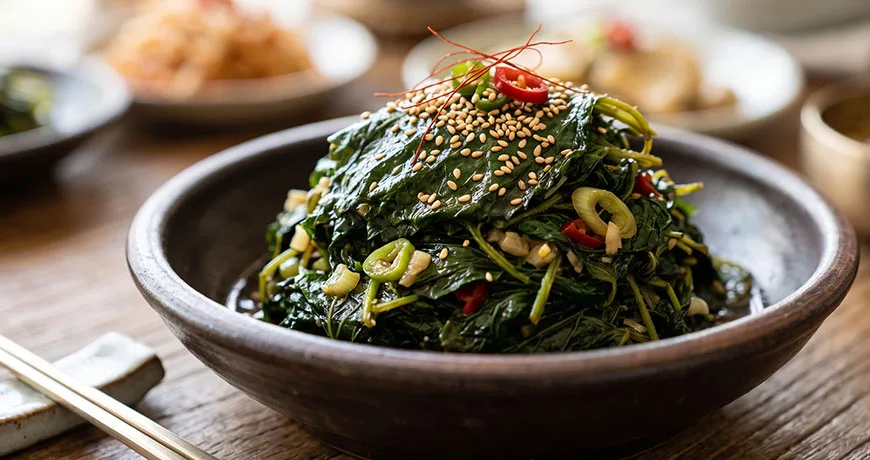
A fragrant and wholesome traditional Korean side dish (banchan) made from tender, young perilla leaves (kkaennip-sun). The leaves are lightly blanched to preserve their vibrant green hue and silky texture, gently squeezed, and stir-fried with fragrant scallions, minced garlic, and savory Korean soup soy sauce (guk-ganjang). Finished with a drizzle of toasted perilla or sesame oil, its signature herbaceous, minty-licorice aroma instantly awakens the appetite.
⏱️ Total: 20 mins | Prep: 10 mins (washing & blanching) | Cook: 10 mins | 🍳 Easy | 🌿 Herbaceous & Aromatic | 🥬 Rich in Iron & Calcium
Ingredients (2-3 servings)
- Main Ingredients: 200g young, tender perilla leaves or perilla shoots (kkaennip-sun), 1/2 tsp coarse salt (for blanching water), 1.5 tbsp perilla oil (deulgireum) or cooking oil
- Seasoning & Aromatics: 1.5 tbsp Korean soup soy sauce (guk-ganjang / Joseon-ganjang or light soy sauce), 1 tsp minced garlic, 2 tbsp finely chopped green onion, 1/4 cup water or anchovy-kelp broth
- Finishing Touches: 1 tbsp perilla seed powder (deulkkae-garu, optional for extra nutty richness), 1 tsp toasted perilla or sesame oil, 1 tsp toasted sesame seeds
Allergy Information
- Contains: Soy (Soy sauce), Wheat (Soy sauce), Sesame (Vegan-friendly if using vegetable broth)
Equipment
- Large Stockpot (for blanching), Colander, Frying Pan or Wok, Kitchen Tongs, Spatula, Mixing Bowl
Cooking Instructions
- Washing & Trimming: Rinse young perilla leaves thoroughly in cold water 2–3 times to remove any residual soil. Trim off any thick, fibrous woody stems while keeping the tender young leaves and thin stems intact.
- Flash Blanching: Bring a pot of water to a rolling boil and add 1/2 tsp of coarse salt. Plunge the perilla leaves into the boiling water for just 30–40 seconds, pressing them down so they submerge evenly.
- Shocking & Squeezing: Immediately transfer the blanched leaves to a bowl of ice-cold water to stop the cooking process and lock in the vivid green color. Drain and gently squeeze out excess moisture with your hands (do not squeeze completely dry—leave about 10–15% moisture to keep them supple).
- Pre-Seasoning (Mumuchim): Loosen the squeezed clump of leaves. In a bowl, toss the leaves with soup soy sauce, minced garlic, and half of the chopped green onions. Let rest for 5 minutes so the seasonings penetrate the fibers.
- Stir-Frying: Heat 1.5 tbsp perilla oil in a frying pan over medium heat. Add the pre-seasoned perilla leaves and sauté for 2–3 minutes. Pour in 1/4 cup of water or anchovy-kelp broth, lower the heat to medium-low, cover with a lid, and let it simmer for 2 minutes until the leaves become soft and tender.
- Finishing & Serving: Remove the lid, toss in the remaining green onions (and perilla seed powder if using), and stir-fry until the liquid is almost fully absorbed. Turn off the heat, drizzle with toasted perilla oil, and garnish with toasted sesame seeds. Serve warm or chilled as a side dish.
💡 Cooking & Pairing Tips / Health Benefits
- Iron & Calcium Powerhouse (Health Benefits): Perilla leaves are remarkably nutrient-dense, containing more than double the iron content of spinach, along with abundant calcium, vitamin A (beta-carotene), vitamin C, and dietary fiber. Sautéing them in perilla oil enhances the bioavailability of fat-soluble beta-carotene while delivering essential plant-based omega-3 fatty acids.
- Natural Appetite Booster: The distinct, refreshing fragrance of perilla leaves comes from natural aromatic compounds (such as perillaldehyde and rosmarinic acid) that help stimulate digestive juices and revive sluggish appetites.
- Why Pre-Blanching Matters: Blanching young perilla shoots briefly before stir-frying removes any bitter, astringent undertones, softens the fibrous texture, and ensures they stay lush and tender during sautéing without overcooking.
- Perfect Food & Beverage Pairing: An essential staple for traditional Korean vegetable bibimbap, rustic barley rice bowls (boribap), or served alongside grilled meats like bulgogi and pork belly (samgyeopsal) to balance rich, fatty flavors.
Nutrition Facts (Estimated)
- Total Content : Approx. 100g (1 serving)
- Calories : 78 kcal
– Sodium : 362mg
– Total Carbohydrate : 5.0g
– Sugar : 0.8g
– Total Fat : 5.2g
– Saturated Fat : 0.7g
– Cholesterol : 0.0mg
– Protein : 2.7g
– Calcium : 93.0mg
– Vitamin A : 194.0μg RAE
– Iron : 0.8mg
(Daily Values are based on a 2,000 calorie diet and standard Korean nutritional reference values)
The Art of Green Embodying the Soul of the Forest
This young perilla leaf stir-fry is a culinary miracle born from the untamed vitality of the wild and the delicate touch of human hands. The deep herb fragrance contained within a single green leaf evokes the illusion of biting directly into a breeze cradled by the morning dew of a deep forest. The overwhelming explosion of aroma hidden beneath the humble appearance of simple foliage delivers a primitive yet pure sensory shock that extravagant ingredients simply cannot match.
Blanched to a silk-like tenderness, the leaf tissues absorb the pungency of scallions and minced garlic, the clarity of soy seasoning, and the rich nuttiness of perilla oil woven into every fold. Stir-fried in a single breath over high heat, the inherent volatile aromas of the perilla meet the emulsifying power of the oil to map a multi-dimensional topography of flavor in the mouth. The bittersweet, lingering aftertaste released with every chew instantly purifies the hyper-stimulated modern palate, returning us to the purity of the earth and completing a height of gastronomic pleasure.
True gastronomy does not rely solely on expensive rare ingredients or flamboyant techniques. Ggaennip-namul-bokkeum is the essence of Korean dining, drawing out cosmic aromatics and absolute textural harmony from the most common and familiar leaves. Clearing away this single plate today is a tender, restorative ritual offered by the earth to souls momentarily lost in a noisy world.
Editor’s Review
A Breathtaking Symphonic Fusion of Etheric Perilla Aromas and Rich Umami Glaze
The moment the tender, meticulously blanched young perilla leaves—lightly stir-fried with the pungent notes of scallions and garlic, wrapped in a shimmering glaze of clean soy and rich perilla oil—hit the palate, an overwhelming wave of forest-fresh herb aroma and deep, savory umami floods the senses. The brilliant, harmonious interplay between the subtle bitterness of the emerald leaves and the velvety, nutty finish delivers an endlessly satisfying and dynamically transcendent culinary experience.
Culinary Mastery Forged by Chlorophyll-Preserving Blanching Dynamics and High-Heat Emulsion Science
Ggaennip-namul-bokkeum stands as a masterclass in traditional Korean green vegetable craft, utilizing a rapid blanching stage to neutralize raw notes and lock in vibrant chlorophyll before applying high-heat sautéing with aromatic oils to maximize volatile aromatics. Managing thermal intensity to relax rigid plant fibers into silk-like textures while deeply saturating every fold with balanced seasonings represents fundamental culinary science that achieves absolute textural harmony.
Heartwarming Solace Rooted in the Untamed Vitality of the Earth and the Sanctuary of Home
Overflowing with the raw, vibrant vitality of seasonal greens and the gentle warmth of traditional home cooking, a neatly prepared plate of stir-fried perilla leaves acts as a comforting remedy for daily weariness, anchoring a tired spirit in unpretentious, grounding comfort. Savoring this fragrant, nutrient-dense delicacy washes away modern exhaustion, granting an authentic sanctuary of peace, emotional recovery, and renewed life.