
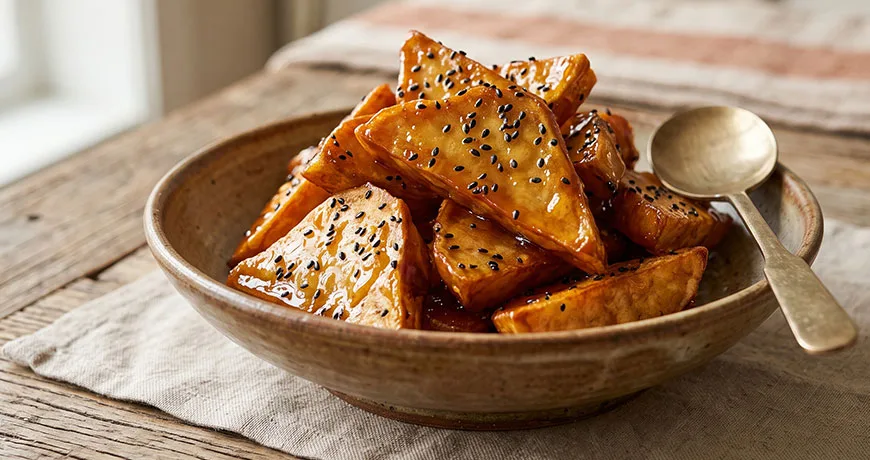
Gogumamattang is a masterpiece of carbohydrate engineering that hydrodynamically gelatinizes amylose starches inside sweet potato cells while leveraging beta-amylase enzymatic activity to naturally saccharify those starches into sweet maltose. When cubed sweet potatoes are submerged in high-heat lipids, surface moisture violently flashes off, creating a rigid dehydrated crust while the interior cooks to a tender, fluffy state. The core engineering of this dish lies in heating a sucrose-and-polysaccharide syrup to a precise thermal window (150–160°C) to transform it into an amorphous, glassy solid state (sugar glass), which is then instantaneously coated over the fried sweet potato cubes. The resulting matrix delivers an extreme textural duality: a glass-like crackly exterior encasing a pillowy, sweet interior.
- ⏱️ Total: 35 mins | Prep: 10 mins (Cubic sizing & surface moisture stabilization) | Cook: 25 mins
- 🍳 Difficulty: Medium-High (Requires precise management of internal sweet potato gelatinization and sucrose glass-transition control)
- 🌶️ Profile: Deeply Sweet with a Shattering, Caramelized Glass Shell and Fluffy Interior
- 🍚 Focus: Enzymatic Saccharification, Lipid Convection Frying, & Molten Glass Coating
Ingredients (2–3 servings)
- Amylose Starch Matrix: 3 Firm Sweet Potatoes (Cut into uniform bite-sized 3cm cubes—uniformity is vital to synchronize frying times)
- Glassy Sucrose Matrix: 3 tbsp White Sugar (Sucrose – for forming the glass shell), 2 tbsp Corn Syrup or Rice Syrup (Polysaccharide binder to prevent undesirable recrystallization)
- Lipid Convection Medium: 3+ cups Cooking Oil (Deep enough to submerge and convection-fry the cubes)
- Lipid Finish Matrix: 1.5 tbsp Cooking Oil (for the pan syrup phase), 1 tsp Black and White Sesame Seeds
Allergy Information Contains: None (100% Plant-based matrix)
Equipment Deep Frying Pot, Skimmer, Wide Non-Stick Pan or Wok, Sheet Pan or Parchment Paper (for cooling)
Cooking Instructions
- Cubic Sizing & Surface Dehydration: Cut the sweet potatoes into uniform 3cm cubes. Submerge in cold water for 5 minutes to rinse away surface starch, then thoroughly pat dry with paper towels. (Residual surface water will cause dangerous oil splattering and soggy crusts.)
- Lipid Convection & Gelatinization: Submerge the sweet potato cubes in oil preheated to 170°C. Fry over medium heat for 8–10 minutes to allow internal amylase enzymes to saccharify the starches while gelatinizing the core. Increase the heat to 180°C for the final 2 minutes to crisp the exterior, then drain thoroughly on a wire rack.
- Molten Sugar Glass Construction: In a separate wide pan, combine 1.5 tbsp of cooking oil, 3 tbsp of sugar, and 2 tbsp of corn syrup. Heat over medium-low without stirring. Allow the sugar to melt and foam into a bubbling, molten state (approx. 150–160°C). (Stirring introduces nucleation sites that cause unwanted sugar recrystallization; simply swirl the pan gently if needed.)
- Glass Transition Coating: The absolute moment the syrup turns a pale, amber hue and reaches peak viscosity, immediately introduce the fried sweet potato cubes. Turn off the heat and aggressively toss the pan to force the molten glass syrup into a thin, uniform veneer over every cube.
- Flash-Cooling & Crystallization: Transfer the coated cubes individually onto an oiled tray or parchment paper to prevent sticking. Allow them to sit at room temperature for 1–2 minutes; the syrup will instantly solidify into a shattering, crystalline glass shell. Garnish with black and white sesame seeds.
💡 Professional Culinary Tips
- The Beta-Amylase Temperature Window: Sweet potatoes house high concentrations of beta-amylase, which operates at peak efficiency between 55°C and 75°C, converting complex starches into sweet maltose. Starting the fry at a moderate temperature allows the interior to traverse this enzymatic window, maximizing natural sweetness before the enzymes denature at higher heats.
- Preventing Recrystallization via Polysaccharides: Pure sucrose melted alone will cool into a brittle, grainy powder rather than a smooth glaze. Introducing corn syrup (glucose/fructose polymers) intersperses long-chain molecules that physically block sucrose molecules from reforming crystals, maintaining a smooth, glossy glass matrix.
- Physics of the Glassy State: The crispy outer coating of Mattang is an amorphous solid—a sugar glass. By rapidly cooling the molten sucrose without letting it organize into crystal lattices, it forms a rigid barrier that locks in internal moisture while delivering an addictive sensory crunch.
🍶 Gastronomic Pairing
- Biochemical Palate Cleansing: When the dense carbohydrates, shattering sugar glass, and frying lipids heavily coat your oral mucosa, pair this rich matrix with a bitterly sharp, highly acidic iced Americano or espresso. The roasted coffee alkaloids act as a surgical scalpel, cleanly slicing through the intense sucrose sweetness and resetting your palate for the next bite.
Nutrition Facts (Estimated)
Total Content : Approx. 200g (1 serving)
Calories : 380 kcal (High-carbohydrate, high-sugar energy matrix)
– Sodium : 15mg (Trace amounts)
– Total Carbohydrate : 62.0g (Sweet potato starches, maltose, and sucrose/syrup polysaccharides)
– Sugar : 28.0g (Glass shell coating and enzymatic saccharification sugars)
– Total Fat : 12.5g (Absorbed frying lipids and pan coating oils)
– Saturated Fat : 1.5g
– Cholesterol : 0.0mg (100% Vegan matrix)
– Protein : 2.0g (Plant-based protein)
– Dietary Fiber : 4.5g (Sweet potato cellulose)
*Daily Values are based on a 2,000 calorie diet and standard Korean nutritional reference values.
**Nutritional values are calculated based on original ingredients; substitutions may alter specific macronutrients.
Origins and Food Culture of Deep-fried and Sugar Glazed Sweet Potatoes (Gogumamattang)
1. Historical Lineage: Introduction as a Famine Relief Crop and Sugar Glaze Evolution
- Native to Central America, sweet potatoes were introduced to the Korean peninsula in 1763 (during the reign of King Yeongjo) when royal emissary Jo Eom brought back seeds from Tsushima Island, planting them in Dongnae and Seoul. During eras of rice scarcity, sweet potatoes thrived in barren soils, serving as a vital famine relief crop (guhwang-jakmul) that rescued starving peninsular populations.
- Following the Japanese colonial period and modernization, as white sugar and vegetable cooking oils became widely accessible, traditional consumption evolved beyond simple boiling or roasting. Dicing, deep-frying, and tossing sweet potatoes in sugar or grain syrup syrups established a distinct culinary identity. Influenced by Chinese basa (spun-sugar coating) techniques and adapted to Korean domestic preferences, Gogumamattang blossomed into an original dessert genre characterized by its shatteringly crisp crust and tender interior.
2. The Culinary Science of Double-Frying and Sugar Caramelization
- The technical mastery of Gogumamattang hinges upon controlling deep-frying temperatures and managing the sugar syrup’s caramelization phase through precise thermal timing.
- Frying sweet potatoes at excessively low temperatures causes them to absorb excessive oil and turn greasy, while high heat chars the exterior before cooking the center. Master kitchens employ a double-frying method at moderate-high temperatures (170–180°C) to completely drive off moisture and maximize surface crispness. Subsequently, melting sugar and oil in a pan without agitation allows controlled caramelization before rapidly tossing the fried sweet potatoes; this prevents sugar recrystallization into hard lumps, yielding a thin, transparent glass glaze that represents the pinnacle of confectionery and culinary science.
3. The Nostalgic School-Gate Treat and Universal Soul Dessert
- During the 1970s and 1980s, Gogumamattang steamed and bubbled in huge cast-iron vats outside school gates and neighborhood markets, serving as the sweetest, most cherished after-school snack for hungry students.
- Though reinterpreted across modern fine dining desserts and trendy café menus today, the rustic, deep sweetness whipped up by mothers in large home kitchen pots remains an immortal cultural monument to Korean childhood nostalgia, comfort dining, and cherished culinary heritage.
The Glassy Amber Shell of Caramelized Sucrose, the Fluffy Mealy Interior of High-Starch Tubers, and the Confectionery Heritage of Joseon Sweet Potatoes: A Refined Portrait of Gogumamattang
Gogumamattang (Deep-fried and Sugar Glazed Sweet Potatoes) stands as the indulgent, shatteringly crisp, and biologically fascinating summit of Korea’s traditional confectionery (gan-sik) gastronomy. Centered upon choice yellow-fleshed sweet potatoes (Ipomoea batatas or Goguma)—cultivated within fertile, well-drained soils to accumulate dense reserves of branched amylopectin starches and natural sweetening sugars—the preparation begins with rustic culinary discipline. Following rough peeling and geometric angular butchery into rugged, uneven triangular chunks (ramdaegi), the sweet potato pieces are rinsed briefly in cold water to purge loose surface starches before undergoing absolute surface dehydration. Submerged inside a deep iron cauldron or heavy fryer filled with clean vegetable oil, the tubers undergo a rigorous double-frying (deobeul-peuraing) protocol between 170°C and 180°C: the initial frying flash-vaporizes internal moisture to swell the cellular mesophyll into a fluffy, pillowy interior, while the subsequent high-heat immersion instantaneously expels peripheral moisture to establish a rigid, cork-like crust. Concurrently, a separate pan is loaded with granulated sugar, high-maltose corn syrup, and a splash of cooking oil; heated gently over medium flame without agitation, it melts into a transparent amber syrup. The crisp, fried sweet potatoes are immediately plunged into this bubbling bath, tossing rapidly to encase each angular chunk in a sticky, molten sugar glaze. Transferred to an oiled ceramic plate or wire rack to undergo rapid cooling (tempering), the sugar shell solidifies into an immaculate, glassy state. Transcending the boundaries of simple agrarian root vegetable cookery, this masterclass in thermal carbohydrate manipulation represents the absolute pinnacle of traditional Korean glazed dessert gastronomy.
Approaching the white ceramic plate as fractured amber facets catch the ambient light, lifting a glistening chunk of Gogumamattang with chopsticks releases an immediate, deeply comforting olfactory charge: the rich, toasted caramel aroma of heated sucrose and maltose mingles seamlessly with the warm, buttery starch perfume of freshly fried sweet potato and the nutty fragrance of scattered sesame seeds. Sinking your teeth into the chunk delivers an extraordinary textural revelation: the exterior glassy sugar crust shatters with a crisp, audible snap (ppajik), giving way instantly to the interior mesophyll, which melts across the palate with pillowy, cloud-like tenderness. The sharp, shattering sweetness of the amber glaze forms a dramatic, high-contrast dialogue with the earthy, rich vegetable savor of the mealy sweet potato core, coating the oral cavity in a luxurious wave of comforting richness. Pairing each bite with a sip of chilled dongchimi radish broth or bitter green tea cleanses the palate, preparing the senses for the next piece. Fusing the nostalgic warmth of domestic hearths with precise confectionery physics, this golden centerpiece transforms humble root vegetables into an unforgettable masterpiece of sensory delight and profound gastronomic catharsis.
The enduring majesty of Gogumamattang lies in its historical pedigree—tracing back to 1763 (the 39th year of King Yeongjo’s reign), when Jo Eom, serving as a diplomatic envoy (Joseon Tongsinsa) to Japan, secured sweet potato tubers from Tsushima Island and planted them near Dongnae and Busan Port to combat chronic agrarian famine. Evolving from a pragmatic famine-relief crop (guhwang-jakmul) into an aristocratic banquet sweet and a beloved household treat enriched by humanity’s oldest culinary pairings—hot oil and molten sugar—a plate of sweet potato glazed confections remains an irreplaceable monument of agrarian survival, culinary ingenuity, and brilliant Korean gastronomic craftsmanship.
Editor’s Review
1. A Dynamic Harmony of Shattering Amber Glass Crust, Pillowy Mesophyll Core, and Nutty Sesame Crunch
The structural architecture inside the dish delivers an extraordinary, three-tiered choreography between a heat-tempered amorphous glassy sucrose exterior, a fluff-swollen tuber starch matrix, and brittle whole-seed oil friction. The exterior shell of Gogumamattang consists of a thin, rigid glassy state achieved through rapid thermal tempering; under initial tooth pressure, it shatters like spun sugar with an audible, crisp snap (ppajik) that provides immediate masticatory excitement. As the glass shell fractures, the interior sweet potato flesh—having shed excess free water during double-frying—yields with a pillowy, velvety tenderness (posl-posl) that melts across the tongue with zero fibrous resistance. Interspersed toasted sesame seeds supply a light, brittle crunch that punctuates oral transit, ensuring an impeccably balanced, non-fatiguing mouthfeel from the first sweet bite to the last.
2. Double-Frying Moisture Flash-Vaporization, Starch Gelatinization, Sucrose Glass Transition Kinetics, and Pyrolytic Pyrazine Savor
Gogumamattang represents an exacting study in tuber starch physics, sugar thermodynamics, and solid-state phase transitions. Sweet potato flesh is composed predominantly of amylopectin (roughly 80%) and linear amylose (20%); subjection to 170–180°C frying triggers rapid internal water expansion, creating micro-capillary air pockets that yield a light, fluffy core. The second high-heat immersion strips residual surface moisture, creating a dry micro-environment essential for sugar adhesion. In the glazing phase, sucrose and maltose syrups undergo thermal dehydration and partial caramelization over 160°C, transforming into a viscous, high-molecular-weight syrup. Upon contacting the fried sweet potatoes and cooling rapidly on ambient ceramic, molecular motion abruptly freezes, locking the sugar molecules into a non-crystalline, amorphous glassy state (glass transition) that seals internal steam and preserves structural crispness. Furthermore, micro-Maillard reactions between endogenous sweet potato reducing sugars and amino acids during frying generate trace volatile pyrazines and furans (such as 2-furanmethanol), amplifying the rich, baked-tuber aroma without artificial flavorings.
3. The Joseon Tongsinsa Importation Legacy and the Sovereign Apex of Traditional Glazed Confectionery
Introduced to the Korean peninsula by diplomatic emissary Jo Eom from Tsushima Island to rescue starving rural populations, the sweet potato underwent an extraordinary socio-culinary transformation into Korea’s definitive glazed confectionery masterpiece. Proving that humble field crops can be elevated through precise thermal engineering and sugar physics into an exquisite celebration of texture and flavor, Gogumamattang captures the resilient spirit of Korean food history, standing as an enduring sanctuary of domestic comfort, cultural memory, and brilliant culinary artistry.