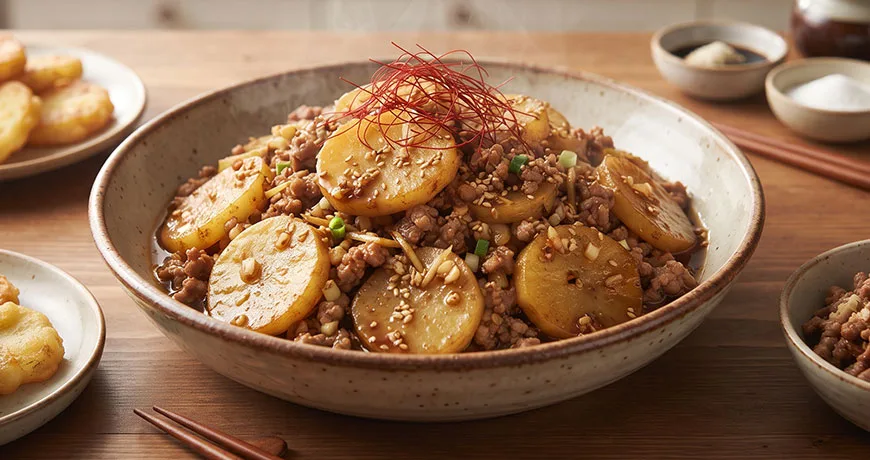
Gamjabokkeum is a masterclass in carbohydrate engineering designed to control the physical behavior of free amylose and amylopectin starches coating potato cell walls while using osmotic pressure to regulate internal cellular moisture, achieving a translucent, chewy texture without mashing. If the free starches released from ruptured cells during slicing are not thoroughly rinsed away with cold water, they undergo rapid gelatinization in the hot pan, binding the pieces together into a dense puree. Following the rinse, a light salting induces cellular osmosis, fortifying the turgor pressure of the potato tissue so it resists breaking during cooking. Coated entirely in a low-temperature lipid barrier and subjected to controlled steam and a gentle Maillard reaction, this high-end side dish emerges with smooth, resilient exteriors and tender, fluffy interiors.
- ⏱️ Total: 30 mins | Prep: 15 mins (Surface starch rinsing & osmotic dehydration) | Cook: 15 mins
- 🍳 Difficulty: Medium (Starch rinsing control and prevention of cell wall collapse during stir-frying)
- 🌶️ Profile: Subtly Sweet Potato Flavor, Clean Savory Notes, with Delicate Maillard Edges
- 🍚 Focus: Free Starch Rinsing, Osmotic Moisture Stabilization, & Low-Temp Lipid Coating
Ingredients (2–3 servings)
- Starch Matrix: 2 Fresh, Firm Potatoes (Julienned to an even thickness of approx. 3mm—uniformity is critical to match starch leaching rates)
- Coloring & Reducing Sugar Matrix: 1/4 Carrot (julienned, for color and trace natural reducing sugars)
- Electrolyte & Moisture Matrix: 1 tsp Salt (for surface rinsing and osmotic water purging)
- Lipid Coating Matrix: 2 tbsp Cooking Oil, 1 tbsp Toasted Sesame Oil
- Aromatic & Allyl Catalyst: 1 tsp Minced Garlic, 1 stalk Green Onion (sliced), 1 tbsp Roasted Sesame Seeds
- Ionized Sodium Binder: Coarse Sea Salt to taste (for final salinity calibration)
Allergy Information Contains: None (100% Plant-based matrix)
Equipment High Thermal Mass Non-Stick Pan or Wok, Strainer, Mixing Bowl, Knife, Cutting Board
Cooking Instructions
- Surface Starch Rinsing: Submerge the uniformly julienned potatoes (approx. 3mm) in cold water for 10 minutes. Gently agitate with your hands to dissolve the free amylose and amylopectin released from the cut cell walls. Rinse thoroughly. (Skipping this will cause the potatoes to stick and mash like paste in the pan.)
- Osmotic Water Stabilization: Drain the rinsed potatoes and toss them evenly with 1 tsp of salt. Let rest for 10 minutes. Osmosis pulls excess free water from inside the potato cells, strengthening their structural integrity to prevent breaking during cooking. Drain well in a strainer, but do not rinse again.
- Low-Temperature Lipid Coating: Heat the cooking oil in a pan over medium heat. Introduce the drained potato matchsticks and minced garlic. Stir-fry gently to coat every potato piece completely in a lipid barrier, controlling moisture evaporation and preventing sudden cell wall rupture.
- Thermal Buffer & Carrot Fusion: Add the julienned carrots and 2 tbsp of purified water. Cover the pan with a lid for 2 minutes to induce a steaming effect. The transfer of heat via water vapor ensures the interior of the potatoes cooks evenly, transforming them into a translucent state.
- Maillard Coating Finish: Remove the lid, allow any remaining moisture to evaporate, and stir lightly until the potato edges show a delicate golden-yellow hue (Maillard reaction). Turn off the heat and fold in the green onions, sesame oil, and sesame seeds, allowing the residual heat to coat the matrix with volatile plant aromatics.
💡 Professional Culinary Tips
- Mechanics of Free Starch Removal: Cutting potatoes ruptures cells, leaving a sticky starch powder on the surface. Under heat, this starch turns to glue and adheres to the bottom of the pan. Cold-water rinsing is non-negotiable to ensure individual potato strips fry independently without clumping.
- Cellular Strengthening via Osmosis: Lightly salting the potatoes is not merely for seasoning. Purging a portion of intracellular free water via osmosis increases cell wall density, preventing thermal mushiness and yielding a resilient, satisfying chew.
- Uniform Heat Transfer via Steaming: Continuously dry-frying potatoes in oil alone causes the outer layers to scorch or dry out while the core remains undercooked. Introducing 2 tbsp of water and covering with a lid for 2 minutes distributes kinetic heat evenly to the core, achieving uniform translucency.
🍶 Gastronomic Pairing
- Biochemical Palate Cleansing: When the fluffy, starch-rich body of the potatoes and the rich lipid coating of the oils coat your oral mucosa, pair this dish with a crisp, highly carbonated Lager Beer or a high-acidity Chilled White Wine. The ethanol and effervescence shear through the micro-starch particles on your tongue, refreshing your palate cleanly.
Nutrition Facts (Estimated)
Total Content : Approx. 200g (1 serving)
Calories : 210 kcal (Carbohydrate-centric energy matrix)
– Sodium : 450mg (Attributed to salt electrolyte calibration)
– Total Carbohydrate : 32.0g (High-density potato starches and carrot reducing sugars)
– Sugar : 2.0g
– Total Fat : 7.5g (Plant-based lipids from cooking oil and sesame oil)
– Saturated Fat : 0.8g
– Cholesterol : 0.0mg (100% Vegan matrix)
– Protein : 3.5g (Plant proteins derived from potatoes)
– Dietary Fiber : 3.0g (Potato and carrot cellulose)
*Daily Values are based on a 2,000 calorie diet and standard Korean nutritional reference values.
**Nutritional values are calculated based on original ingredients; substitutions may alter specific macronutrients.
Origins and Food Culture of Stir-fried Potatoes (Gamjabokkeum)
1. Introduction as a Famine Relief Crop and Joseon Agricultural History
- Native to the high Andes, potatoes were introduced to the Korean peninsula via China during the early 19th century (reign of King Sunjo). Thanks to their rugged vitality and ability to thrive in poor, mountainous soils, they served as a vital survival crop (guhwang-jakmul) that rescued peninsular populations from recurring famines and starvation during the late Joseon period.
- Initially consumed simply boiled or simmered in broths, potatoes evolved into the present-day incarnation of Gamjabokkeum as vegetable cooking oils and frying pans became widely accessible during the late Joseon and modern eras. Nutritionally bridging complex carbohydrates and vitamin C, potatoes cemented their status as an indispensable baseline of traditional domestic banchan.
2. The Culinary Science of Starch Rinsing and High-Flame Pan-Searing
- The technical mastery of Gamjabokkeum hinges entirely upon controlling potato surface starches through water-rinsing (washing) and precise thermal management. Failing to submerge freshly cut potato strips in cold water to leach free starches causes them to agglomerate into a gummy mass that sticks and burns at the bottom of the pan.
- Rinsed and drained potatoes are tossed into pre-heated oil and seared over medium-high heat. This hydrothermal-lipid thermodynamic process ensures that the cellular pectins and starches gelatinize evenly, producing a glossy exterior and a fluffy, tender interior.
3. The Universal Symbol of Korean Home-Cooked Comfort Dining
- Utilizing the two most ubiquitous pantry staples—potatoes and onions—Gamjabokkeum stands as the quintessential embodiment of Korean domestic food culture, evoking fond memories of maternal hearths, school lunchboxes, and neighborhood dining tables.
- Requiring no elaborate techniques beyond salt or soy sauce seasoning to elevate the pure, earthy sweetness of the potato, Gamjabokkeum remains an immortal monument to Korean homestyle banchan identity, unpretentious hospitality, and everyday comfort dining.
The Dense Starch Granules of Daegwaryeong Alpine Potatoes, the Translucent Amylose Glaze of Hydrothermal Gelatinization, and the Crisp Counterpoint of Bell Peppers and Savory Anchovies: A Refined Portrait of Gamjabokkeum
Gamjabokkeum (Stir-fried Potatoes) stands as the comforting, unctuous, and biologically satisfying summit of Korea’s everyday vegetable (banchan) gastronomy, serving as an essential companion to sovereign soup-and-rice (tangban) meals. Centered upon premium Sumi potatoes (Solanum tuberosum or Gamja)—cultivated within the fertile, well-drained sandy loam of high-altitude alpine regions like Daegwaryeong to achieve a pristine balance of starch reserves and reducing sugars—the preparation begins with disciplined prep work. Following meticulous peeling and uniform julienning, the raw potato batons are repeatedly rinsed in cold water to strip away loose surface free starches, preventing sticky agglomeration during pan-searing. The rinsed batons are then subjected to a brief 30-second blanch in boiling salted water, which relaxes internal pectin matrices and shortens subsequent cooking times to eliminate structural breakage. Layered inside a seasoned iron skillet coated in clear vegetable oil or grapeseed oil, julienned onions, sweet paprika, and crisp bell peppers are gently sautéed first to lay a sweet allium foundation before introducing the drained potato batons over medium heat. At the final stage, savory dried anchovies or ham bits are added to introduce calcium and depth, seasoned minimally with clear artisanal soy sauce or salt, and anointed generously with toasted sesame oil and sesame seeds. Bypassing the creamy mash of potato salads or the heavy reductions of braised spuds, Gamjabokkeum harnesses conductive frying heat to preserve the crisp turgor of supporting vegetables while capturing the mealy yet chewy mouthfeel (posl-posl) of the potato core, delivering an intimate and perfectly balanced gastronomic pleasure alongside hot rice and clear soup.
Confronting the white ceramic plate as glistening potato batons coated in a fine oil glaze harmonize with colorful bell peppers and toasted anchovies, lifting a single chopstickful releases an immediate, deeply comforting olfactory charge: the clean, roasted aroma of heated cooking oil mingles seamlessly with the caramelizing sweetness of sautéed onions and the nutty perfume of toasted sesame oil and seeds. Sinking your teeth into a potato julienne reveals an extraordinary textural revelation: the exterior, having undergone blanching and oil frying, yields with a smooth glaze, while the dense starch matrix of the core discharges an energetic, springy bounce (elasticity) coupled with a mealy tenderness that floods the palate with concentrated cereal sweetness. Interspersed pieces of crisp bell pepper provide a refreshing, watery crunch that cleanses the lingering lipid richness, while the savory anchovies amplify the potato’s natural sweetness. Mounding shimmering potato shreds over a spoonful of piping-hot white rice steeped in clear broth completes an unforgettable ritual of domestic solace, nostalgic warmth, and profound gastronomic catharsis.
The enduring majesty of Gamjabokkeum lies in its modern agrarian lineage—introduced to the Korean peninsula through Qing Dynasty trade in the early 19th century and cultivated as a vital famine-relief crop (guhwang-jakmul) within the harsh, rocky mountain terrain of Gangwon and Hamgyong provinces. Evolving into an absolute pillar of domestic dining tables and school lunchboxes (dosirak) following the national flour and potato promotion policies of the 1970s, this unpretentious, golden classic captures the loving resilience of the Korean domestic hearth, standing as an enduring sanctuary of environmental authenticity, maternal solace, and brilliant culinary artistry.
Editor’s Review
1. A Dynamic Harmony of Translucent Starch Glaze, Mealy-Chewy Core Cores, Crisp Bell Pepper Fracture, and Lipid Lubrication
The structural architecture inside the dish delivers an extraordinary, three-tiered choreography between a heat-hydrated starch hydrogel film, turgor-preserved parenchymal tuber cells, crisp vegetable tissues, and an unsaturated lipid phase. Rinsed and blanched prior to frying, the potato batons preserve their structural integrity without breakage, forming a translucent, gelatinized exterior glaze. Biting down reveals a dual texture: an outer smoothness framing an inner core that alternates between a mealy tenderness (posl-posl) and a resilient bounce (elasticity). Interspersed bell peppers and onions fracture under the teeth with an audible, crisp snap that introduces vital masticatory friction, while the vegetable oil and sesame oil form a silky lubricating film across the palate, ensuring an impeccably balanced, non-fatiguing mouthfeel from the first bite to the last.
2. Free Starch Removal via Cold Rinsing, Blanching Pectin Relaxation, Amylose Hydrothermal Gelatinization, Maillard-Caramelization Savor, and IMP-Glutamate Synergy
Gamjabokkeum represents an exacting study in tuber carbohydrate histology, starch gelatinization physics, and pyrolytic flavor chemistry. In raw potato batons, mechanical slicing ruptures surface cells, liberating free starches that cause sticking and clumping during pan-searing; eliminating these via cold immersion and a brief 30-second blanch is the primary thermodynamic prerequisite for crisp textural control. This blanching process partially hydrolyzes insoluble protopectin into soluble pectins, relaxing intercellular adhesion so that conductive pan heat can penetrate uniformly to achieve complete interior gelatinization (posl-posl texture). Concurrently, moderate convective heat (140–160°C) initiates minor Maillard reactions and caramelization between onion reducing sugars and potato starch breakdown products, generating savory roasted aromatic notes. Broth and side-dish savor is driven by cross-ingredient synergy: trace endogenous amino acids within the potato converge with nucleic 5′-inosine monophosphate (5′-IMP) leached from the post-cooking addition of roasted anchovies, triggering an exponential activation across human oral T1R1/T1R3 umami heterodimers. Furthermore, sesamol from sesame oil and allyl sulfides from garlic chemically sequester and mask any trace raw green notes of the potato, securing an immaculate, pure, and comforting savory profile.
3. Gangwon Mountain Terroir, Modern Lunchbox Lore, and the Sovereign Apex of Everyday Tuber Gastronomy
Forged out of the rugged mountainous terroir of Gangwon province and polished within the bustling domestic kitchens and school lunchboxes of modern Korea, Gamjabokkeum represents the undisputed peak of accessible, comforting vegetable cookery in the national canon. Proving that profound culinary comfort requires neither elite extravagance nor complex technique, this golden, unpretentious classic captures the very soul of everyday Korean domestic hospitality, standing as an enduring sanctuary of domestic comfort, seasonal resourcefulness, and brilliant culinary artistry.