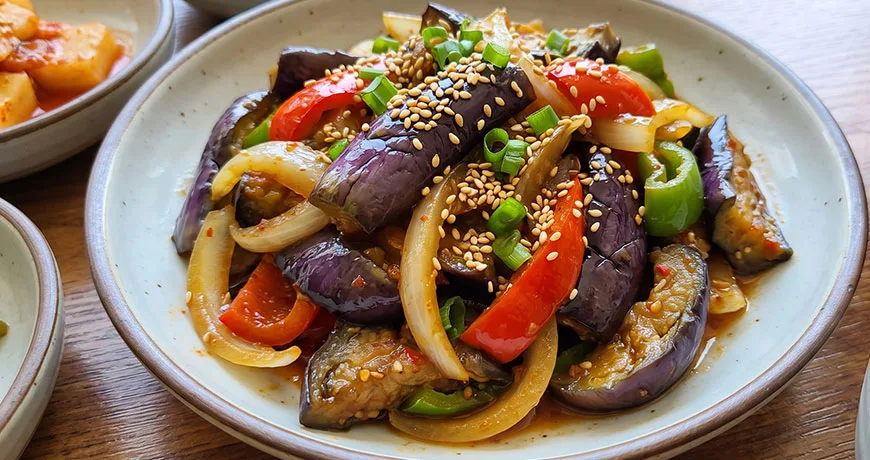
Gajibokkeum is a masterclass in plant-based fluid dynamics and cellular manipulation. The eggplant’s structure is a spongy parenchyma, densely packed with microscopic air pockets. If raw eggplant is tossed directly into hot oil, these pockets act as a powerful vacuum, absorbing copious amounts of lipids and turning the flesh into a greasy, unpalatable mush. The absolute molecular law of this dish requires pre-emptive osmotic dehydration—using sodium ions (salt) to forcibly extract internal cellular water, thereby collapsing the spongy air pockets. Once structurally fortified into a chewy, dense matrix, the eggplant is introduced to a hyper-aromatic lipid base (scallion oil). The ultimate flavor payload is delivered by boiling soy sauce directly on the naked, scorching surface of the pan. This flash-caramelizes the amino acids, triggering an explosive Maillard reaction that coats the chewy eggplant with a profound, smoky umami glaze.
- ⏱️ Total: 25 mins | Prep: 15 mins (Osmotic dehydration & structural collapse) | Cook: 10 mins
- 🍳 Difficulty: Medium (Requires strict control of oil absorption and Maillard heat management)
- 🌶️ Profile: Sweet, Savory, and Smoky Umami with a Bouncy, Viscoelastic Chew
- 🍚 Focus: Osmotic Dehydration, Allyl Sulfide Extraction, & Maillard Caramelization
Ingredients (2–3 servings)
- Porous Spongy Matrix: 2 Fresh Eggplants (Sliced into half-moons. MUST retain the skin to preserve the anthocyanin/nasunin antioxidants and structural integrity)
- Osmotic & Electrolyte Matrix: 1/2 tsp Coarse Salt (Strictly for extracting water and collapsing air pockets)
- Amino Acid & Reducing Sugar Binder: 2 tbsp Soy Sauce, 1 tsp Oyster Sauce (for a massive boost in free glutamate and nucleotides), 1 tbsp Oligosaccharide or Corn Syrup (for surface glazing and moisture retention)
- Allyl & Allicin Catalyst: 1 stalk Green Onion (sliced), 1 tbsp minced garlic
- Lipid Coating Matrix: 2 tbsp Cooking Oil (for extracting scallion aromatics), 1 tbsp Toasted Sesame Oil, 1 tbsp Roasted Sesame Seeds (Added post-heat to preserve volatile aromatics)
Allergy Information Contains: Soy, Wheat (Soy Sauce, Oyster Sauce), Mollusk (Oyster Sauce)
Cooking Instructions
- Osmotic Dehydration (Structural Collapse): Place the sliced eggplants in a mixing bowl and toss thoroughly with the coarse salt. Let sit for 10–15 minutes. Osmotic pressure will force the water out of the cells, collapsing the spongy air pockets. After resting, violently squeeze the eggplant slices with your hands to physically expel the dark, bitter water. (Skipping this step guarantees a greasy, soggy failure.)
- Allyl Sulfide Lipid Extraction: In a cold wok or pan, add the cooking oil and sliced scallions. Turn the heat to medium-low. Slowly heating the scallions vaporizes their internal moisture and extracts the fat-soluble allyl sulfide aromatics, creating a highly fragrant scallion oil base.
- Amino Acid Caramelization (Maillard Reaction): Once the scallion oil is fragrant, add the minced garlic and sauté briefly. Turn the heat up to maximum. Push the aromatics to the side and pour the soy sauce and oyster sauce directly onto the bare, scorching hot surface of the pan. Let it violently boil for exactly 3 seconds. The extreme heat flash-caramelizes the amino acids and sugars, generating a massive burst of smoky Maillard flavor.
- Macro-Emulsion & Injection: Immediately throw the dehydrated, squeezed eggplant into the boiling soy glaze. Stir-fry rapidly and aggressively over high heat. The dense, collapsed eggplant matrix will eagerly absorb the smoky, umami-rich emulsion without becoming soggy, retaining a bouncy, chewy texture.
- Glazing & Aromatic Finish: Once the eggplant is fully coated and tender, turn off the heat completely. While the residual heat is still active, drizzle in the oligosaccharide, sesame oil, and sesame seeds. Toss well. The high-molecular sugars provide a brilliant, appetizing gloss, while the thermodynamic sealing prevents the volatile aroma of the sesame oil from evaporating.
💡 Professional Culinary Tips
- Fluid Dynamics of Spongy Tissue: Throwing un-salted, raw eggplant into hot oil is a molecular disaster. The air pockets expand and suck in the oil, resulting in an unappetizing grease-bomb when chewed. Forcing the structure to collapse via osmosis beforehand physically blocks excessive lipid penetration, ensuring the vegetable remains chewy, firm, and clean-tasting.
- Maillard Reaction via Soy Sauce Boiling: If you pour soy sauce directly over the eggplant slices, it simply acts as a salty marinade. By exposing the soy sauce directly to the blistering metal of the wok, you force the amino acids to break apart and rearrange, creating the highly coveted “Wok Hei” (breath of the wok)—a deep, smoky char that elevates the dish to restaurant quality.
- Anthocyanin Preservation: The vibrant dark purple pigment of the eggplant skin (nasunin) is water-soluble and easily oxidizes into an unappetizing muddy brown when cooked too long. High-heat, rapid stir-frying paired with a final lipid glaze (sesame oil and syrup) encapsulates the pigment, preserving its brilliant color and nutritional value.
🍶 Gastronomic Pairing
- Biochemical Palate Cleansing: When the savory, glossy soy glaze and the aromatic sesame/scallion lipids heavily coat the chewy eggplant matrix, pair this side dish with a sharply chilled, high-acidity Sauvignon Blanc or a Dry Champagne. The sharp tartaric acid and effervescence of the wine act as a precision surgical scalpel. They cleanly slice through the rich plant lipids and heavy glutamate on your palate, completely resetting your taste receptors and elegantly amplifying the eggplant’s natural earthy undertones.
Nutrition Facts (Estimated)
Total Content : Approx. 250g (1 serving)
Calories : 185 kcal (Low-calorie, high-fiber matrix)
– Sodium : 850mg (Attributed to coarse salt, soy sauce, and oyster sauce)
– Total Carbohydrate : 16.0g (Eggplant dietary fiber and oligosaccharide reducing sugars)
– Sugar : 8.0g
– Total Fat : 12.0g (Cooking oil for scallion extraction and sesame oil lipids)
– Saturated Fat : 1.5g
– Cholesterol : 0.0mg (100% Vegan matrix if oyster sauce is excluded)
– Protein : 3.0g (Trace plant proteins)
– Dietary Fiber : 6.5g (High-density spongy cellulose from eggplant)
*Daily Values are based on a 2,000 calorie diet and standard Korean nutritional reference values.
**Nutritional values are calculated based on original ingredients; substitutions may alter specific macronutrients.
Origins and Food Culture of Stir-fried Eggplant (Gajibokkeum)
1. Silla Dynasty Lineage and Classical Treatises (Sikryo Chanyo, Dongui Bogam)
- Native to the Indian subcontinent, the eggplant was introduced to the Korean peninsula during the Three Kingdoms period; ancient records note that Silla-grown eggplants were renowned for their sweet flavor and exported to Tang Dynasty China.
- In the 15th-century Joseon dietary therapy treatise Sikryo Chanyo, royal physician Jeon Sun-ui detailed therapeutic culinary preparations using eggplant to clear visceral heat from the stomach and intestines. Furthermore, Heo Jun’s 1613 medical compendium Dongui Bogam recorded eggplant as Gaja (茄子), praising it because “its nature is cool, its flavor sweet, and it is non-toxic; it regulates chills and fever, clears the qi of the five viscera, promotes blood circulation, and dissolves swelling and boils,” cementing its centuries-old reputation as an essential summer cooling tonic.
2. The Culinary Science of Spongy Parenchyma and High-Flame Lipid Glazing
- While historic Joseon manuscripts (such as Siuijeonso and Gyuhap Chongseo) predominantly featured steamed and torn eggplant salads (Gajinamul) or salted preserves, the development of modern stir-frying (bokkeum) emerged as culinary oils became widely accessible.
- The chief culinary challenge of eggplant lies in its air-filled, spongy cellular structure, which can easily turn greasy if braised at low temperatures. Traditional Korean cooks perfected a two-stage thermodynamic technique: either dry-searing the batons in an ungreased pan to evaporate surface moisture or lightly salting them before flash-frying in hot scallion oil. This seals the exterior, allowing the sweet juices to concentrate within while the savory soy sauce and aromatics caramelize into a clinging, glossy glaze.
3. The Nostalgic Hearth of Garden Banchan and Korean Comfort Dining
- Plucked fresh from backyard garden vines nestled beneath earthen eaves, Gajibokkeum represents the quintessential warmth of Korean domestic food culture—a humble, economical banchan that transforms simple garden produce into a rich, savory centerpiece with nothing more than soy sauce, garlic, and scallions.
- Often regarded as a nostalgic marker of culinary maturity—transitioning from a childhood aversion to its soft texture into an adult appreciation for its luscious, velvety depth—Stir-fried Eggplant remains an immortal soul banchan anchored across homestyle set meals (Baekban), school lunch trays, and family dinner tables across the peninsula.
The Spongy Cellular Porosity of Sun-Ripened Purple Eggplant, the Nutty Lipid Glaze of Cold-Pressed Perilla Oil, and the High-Heat Maillard Savor of Fermented Soy Essence: A Refined Portrait of Gajibokkeum
Gajibokkeum (Stir-fried Eggplant) stands as the comforting, unctuous, and biologically fascinating summit of Korea’s midsummer vegetable (banchan) gastronomy, serving as an indispensable textural counterpart to sovereign soup-and-rice (tangban) meals. Centered upon choice summer eggplants (Solanum melongena or Gaji)—swollen with subterranean groundwaters and cloaked in glistening violet carapaces saturated with potent anthocyanins (principally nasunin)—the preparation begins with anatomical discipline. Because the interior flesh of raw eggplant consists of a porous cellular network holding over ninety percent air and moisture, the cylinders are cut into thick diagonal batons or crescent rounds and lightly tossed with solar sea salt to induce rapid osmotic weeping, collapsing redundant intercellular air pockets before the vegetable meets the pan. Layered inside a seasoned iron skillet or curved wok coated in aromatic, cold-pressed toasted perilla oil (deulgireum), finely chopped scallions and crushed garlic are gently sautéed first to infuse the unsaturated lipids with fragrant allicin metabolites. When the eggplant batons are introduced over an aggressive, licking flame, they display a dynamic physical transformation: initially devouring the cooking oil like an organic sponge, the parenchymal cells rapidly collapse under sustained convective heat, expelling the absorbed lipids back into the pan. At this critical moment of oil release, aged artisanal soy sauce (Joseon ganjang or clear soup soy) is flashed along the searing perimeter of the pan, detonating an intoxicating cloud of caramelized Maillard aromatics. Finished with crisp ribbons of green Cheongyang chilies, sweet white onions, and a generous blizzard of toasted sesame seeds, Gajibokkeum represents a triumph of botanical heat mechanics. Bypassing the watery flaccidity of simple steamed eggplant salads (gajinamul), this stir-fry binds crisp dermal elasticity with an opulent, custard-like interior, delivering an unmasked burst of clean vegetable sweetness that enriches the palate alongside a bowl of hot soup and rice.
Confronting the glistening dish as fragrant golden steam curls upward from glossy, soy-lacquered purple batons, lifting a tender piece with metal chopsticks releases an immediate, deeply comforting olfactory charge: the savory, roasted perfume of high-heat caramelized soy sauce mingles seamlessly with the deep, toasted nuttiness of cold-pressed perilla oil, the sweet sulfurous warmth of wilted scallions, and the crisp botanical brightness of fresh chilies. Resting the eggplant across the tongue and applying gentle tooth pressure delivers an extraordinary textural revelation: the glossy purple skin yields with a supple, elastic pop, giving way instantly to the interior pulp, which has collapsed into an unctuous, velvet-like purée that floods the oral cavity with sweet, succulent plant juices. Any trace of raw vegetable astringency has completely vanished, replaced by the deep amino acid savor of fermented soy, which coats the palate in a frictionless embrace. Sliced Cheongyang chilies fracture between the teeth with a refreshing, audible snap (ajak), slicing through the rich lipid glaze and restoring sensory equilibrium. Mounding a shimmering eggplant baton over a spoonful of piping-hot white rice steeped in clear broth and swallowing the combination completes an unforgettable ritual of domestic comfort, seasonal rejuvenation, and profound gastronomic catharsis. The enduring majesty of Gajibokkeum lies in its deep agrarian lineage—cultivated across the Korean peninsula since the Unified Silla and Goryeo eras and chronicled in classical agricultural treatises such as Sanga Yorok and Hyangyak Gugeupbang. Esteemed in traditional Korean medicine for its cool thermodynamic nature, capable of clearing stagnant internal heat and promoting healthy vascular circulation during the sweltering dog days (Sambok), the eggplant was transformed through maternal wisdom into a masterwork of everyday pan cookery. Extracting the pure potential of humble garden plots through the complementary alchemy of perilla lipids and fermented soy, a steaming plate of stir-fried eggplant remains an irreplaceable monument of botanical stewardship, domestic solace, and brilliant Korean culinary craftsmanship.
Editor’s Review
1. A Dynamic Harmony of Elastic Cuticular Snap, Custard-Soft Parenchymal Dissolution, Crisp Chili Fracture, and Frictionless Lipid Coating
The structural architecture inside the vessel delivers an extraordinary, three-tiered choreography between a heat-resilient anthocyanin cuticle, thermally collapsed parenchymal storage tissue, crisp allium-capsicum matrices, and an unsaturated botanical lipid phase. Sautéed over aggressive conductive heat, the exterior violet skin loses surface water rapidly without toughening, preserving a supple, viscoelastic snap (elasticity) that resists tooth pressure with pleasant chew. In luxurious contrast, the spongy interior flesh undergoes complete middle-lamella pectin dissolution, causing its delicate cell walls to collapse into an ethereal, custard-like purée that melts across oral tissues with zero friction. Sliced Cheongyang chilies and onions retain their high cellular turgor, fracturing under the teeth with an audible, crisp snap that introduces vital masticatory friction, while the toasted perilla oil forms a silky lubricating film across the palate, ensuring an impeccably balanced, non-fatiguing mouthfeel from the first bite to the last.
2. Spongy Capillary Lipid Uptake and Heat-Induced Syneretic Expulsion Rheology, High-Heat Soy Maillard Kinetics, Glutamate-Fructose Umami Synergism, and Nasunin Lipophilic Stabilization
Gajibokkeum represents an exacting study in botanical histology, lipid interface mechanics, and pyrolytic flavor chemistry. In raw eggplant, intercellular air spaces account for 50–60% of total parenchymal volume, creating a powerful capillary network that voraciously absorbs ambient frying oils upon initial pan contact (120–140°C). As thermal energy penetrates the tissue, intracellular water vaporizes and structural pectins depolymerize, triggering rapid cellular collapse that squeezes the trapped perilla oil back out into the pan (phase inversion). Flashing aged soy sauce along the scorching margins of the pan (>150°C) initiates violent Maillard reactions between reducing sugars and free amino acids, generating complex aromatic pyrazines, furans, and maltol that instantly dissolve into the expelled lipids, coating each baton in a clinging, savory emulsion. Broth savor is governed by a profound cross-ingredient synergy: high concentrations of microbially derived free glutamic acid (Glutamate) in the fermented soy converge with endogenous fructose, glucose, and aspartic acid within the eggplant pulp, triggering an exponential activation across human oral T1R1/T1R3 umami heterodimers. Furthermore, the purple anthocyanin pigment nasunin (delphinidin-3-rutinoside) is protected from oxidative degradation and thermal bleaching by the hydrophobic perilla lipid barrier, preserving its vivid hue and biological antioxidant capacity. Simultaneously, allyl sulfides from garlic and scallions chemically mask trace bitter glycoalkaloids (solanine), yielding an immaculate, pure, and comforting savory profile.
3. Agrarian Backyard Terroir, Goryeo Literary Heritage, and the Sovereign Apex of Everyday Plant-Based Banchan
Celebrated as early as the 13th-century Goryeo poetic anthology Hallim Byeolgok for its noble purple form, the eggplant occupies a foundational pedestal in Korean culinary history. Illustrating how minimalist pan-searing and the strategic synergy of traditional seed oils can transform an ordinary garden vegetable into an unctuous, deeply savory companion for sovereign soups, Gajibokkeum stands as an enduring sanctuary of domestic comfort, seasonal resourcefulness, and brilliant Korean culinary artistry.