
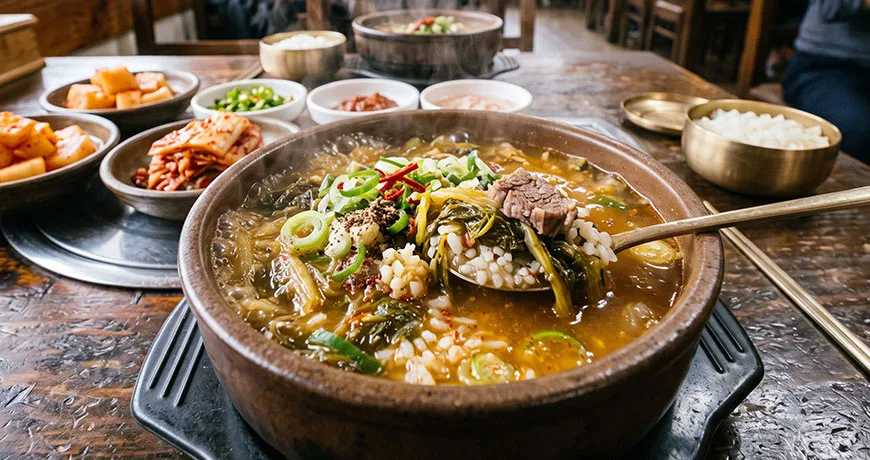
Ugeojisagolgukbap is a masterclass in exploiting colloidal suspensions and thermal hydrolysis to conquer rigid plant fibers. The foundation is Sagol, an unctuous, milky-white beef bone broth created by emulsifying bone marrow lipids and hydrolyzed collagen through hours of kinetic boiling. This macromolecular suspension acts as a thermal and chemical medium to break down Ugeoji—the tough, chlorophyll-rich outer leaves of the Napa cabbage. By violently massaging a hypertonic, fermented soybean paste (Doenjang) into the cabbage leaves before boiling, osmotic pressure forces the savory amino acids deep into the cellular walls. As the soup simmers, the animal lipids in the bone broth coat and thermally hydrolyze the tough cellulose into a porous, melt-in-your-mouth matrix. When combined with rice, the sticky amylopectin starches drink in the colloidal broth, resulting in an exceptionally velvety mouthfeel and a profound umami synergy.
⏱️ Total: 1 hr 20 mins | Prep: 20 mins | Cook: 1 hr | 🍳 Difficulty: Moderate (Requires preservation of the colloidal emulsion and strict cellulose hydrolysis) | 🌶️ Profile: Deeply Earthy, Savory, and Unctuously Creamy | 🍚 Focus: Colloidal Suspension, Osmotic Infusion, & Cellulose Hydrolysis
Ingredients (2–3 servings)
- Colloidal Umami Solvent: 1.5L Sagol broth (Rich, milky beef bone broth)
- Structural Fiber Matrix: 300g boiled Ugeoji (Outer leaves of Napa Cabbage – excess kinetic water violently squeezed out)
- Hypertonic Fermented Binder: 3 tbsp Doenjang (traditional Korean fermented soybean paste), 1.5 tbsp Gochugaru (chili flakes), 1.5 tbsp minced garlic, 1 tbsp soup soy sauce, 1 tbsp perilla oil (or sesame oil)
- Aromatics: 1 stalk green onion, 1 green chili pepper (sliced)
- Starch Matrix: 2 bowls of warm, cooked white rice
Allergy Information Contains: Beef, Soy, Wheat (from Doenjang and soy sauce)
Equipment Heavy-bottomed Pot or Ttukbaegi (Korean earthenware pot), Mixing Bowl, Cutting Board, Knife
Cooking Instructions
- Mechanical Cleavage: Take the pre-boiled Ugeoji and squeeze it aggressively to remove at least 80% of its moisture. This removes turgor pressure and creates empty microscopic pockets within the fiber matrix for the broth and marinade to fill. Tear the leaves lengthwise or cut them into bite-sized pieces.
- Osmotic Infusion & Lipid Coating: In a mixing bowl, combine the Ugeoji with the Doenjang, Gochugaru, soup soy sauce, minced garlic, and perilla oil. Use your hands to forcefully knead the paste into the fibers. The high salinity creates osmotic pressure, injecting fermented glutamates directly into the rigid plant cells while the perilla lipids coat them. Let rest for 10 minutes.
- Colloidal Boiling: Pour the milky Sagol bone broth into a heavy pot and bring to a rolling boil over high heat. Add the osmotically marinated Ugeoji, cover the pot, and reduce the heat to a low simmer.
- Thermal Hydrolysis: Simmer gently for 40 to 50 minutes. The continuous kinetic heat, combined with the fatty acids and gelatin suspended in the Sagol broth, chemically weakens the tough pectin and cellulose bonds of the cabbage, transforming it from a rubbery leaf into a luxuriously soft sponge.
- Aromatic Balancing & Plating: Once the Ugeoji offers zero resistance to the bite, stir in the green onion and chili pepper. Simmer for 3 more minutes to release their volatile essential oils. Serve boiling hot alongside warm rice, allowing the starches to rapidly hydrate and fuse with the colloidal emulsion.
💡 Professional Culinary Tips
- The Colloidal Mechanics of Sagol: Boiling beef bones at high temperatures for hours forces the fats from the bone marrow to violently collide with water molecules and extracted collagen. This creates a highly stable, milky-white micro-emulsion (a colloid). In the soup, this gelatinous matrix acts as a stabilizer, preventing the particulate matter of the Doenjang from sinking to the bottom, ensuring every single spoonful is uniformly creamy and rich.
- The Rheological Necessity of Massaging: Dropping Ugeoji straight into broth and stirring in Doenjang results in flavored water and bland vegetables. Aggressively massaging the fermented paste into the leaves beforehand is a deliberate biochemical technique. It uses osmotic diffusion to force the salty, savory compounds past the tough plant cell walls, guaranteeing the fiber itself tastes as rich as the soup.
- Fatty Acids and Chlorophyll Protection: The dark outer leaves of cabbage are far tougher than the yellow core, but they pack significantly more vitamins and minerals. The dense animal lipids present in the Sagol broth physically coat the plant fibers during the long boiling process. This lipid barrier shields sensitive nutrients from rapid oxidative destruction while massively increasing the bioavailability of fat-soluble vitamins upon digestion.
Nutrition Facts (Estimated)
Total Content : Approx. 650g (1 serving, including rice)
Calories : 520 kcal
– Sodium : 920mg
– Total Carbohydrate : 72.0g
– Sugar : 4.0g
– Total Fat : 14.0g (Lipids derived from beef bone marrow)
– Saturated Fat : 5.0g
– Cholesterol : 15.0mg
– Protein : 22.0g
– Dietary Fiber : 12.0g
*Daily Values are based on a 2,000 calorie diet and standard Korean nutritional reference values.
**Nutritional values are calculated based on original ingredients; substitutions may alter specific macronutrients.
Origins and Food Culture of Korean Cabbage and Rice Soup (Ugeojisagolgukbap)
1. Ancestral Zero-Waste Wisdom: Upcycling Outer Cabbage Leaves (Ugeoji)
- Tracing its roots back to Korea’s traditional harvest preservation practices, where the fibrous outer leaves trimmed away during late-autumn kimchi making (gimjang) were boiled, dried, and stored as an indispensable vitamin and mineral reservoir for harsh winters.
- By combining these fibrous greens with slow-boiled cattle bone broth instead of expensive cuts of meat, common households created an affordable, high-calcium, nutrient-dense restorative staple that sustained families through scarce winter months.
2. The Culinary Science of Pre-Seasoning (Jomul-jomul) and Cauldron Simmering
- The hallmark of authentic preparation lies in hand-tossing (jomul-jomul) the blanched cabbage with aged fermented soybean paste (doenjang), minced garlic, chili flakes, and sesame oil before adding it to the simmering bone stock, ensuring the seasonings penetrate deep into every leaf fiber.
- Slow cauldron simmering allows the rich, milky collagen of the bone broth to marry seamlessly with the savory umami of doenjang, eliminating greasy heaviness while yielding a velvety, soothing broth and exquisitely tender greens.
3. A Soul-Warming Winter Comfort Classic and Traditional Banchan Pairing
- Gathering around a steaming earthenware bowl in winter marketplaces and neighborhood diners embodies the warmest, most generous spirit of Korean culinary hospitality.
- Enjoyed by ladling the scalding broth over rice and crowning each spoonful with crisp, tangy cubed radish kimchi (kkakdugi) or freshly made geotjeori, the contrast between rich savory warmth and crisp acidity delivers an enduring comfort food experience.
The Silken Richness of Slow-Simmered Ox Bone Broth and the Earthy Grace of Soy-Seasoned Cabbage Greens: A Refined Portrait of Ugeojisagolgukbap
Ugeojisagolgukbap (Korean Cabbage and Beef Bone Soup with Rice) stands as the humble, deeply nourishing, and biologically harmonious summit of Korean tangban (soup-and-rice) gastronomy. Fibrous, dark-green outer leaves of Napa cabbage (ugeoji)—harvested and parboiled during the late-autumn Kimchi-making season—are lovingly seasoned with traditional fermented soybean paste (doenjang), minced garlic, toasted sesame oil, and red chili flakes. They are then introduced into a massive cauldron of rich, milky beef bone broth (sagol-yuksu) that has been slow-simmered for days, gently braised over a low flame until the greens are meltingly tender, and served scalding hot over a bowl of steeped white rice. Rather than relying on expensive cuts of meat, this dish elevates humble, preserved botanical leaves into an opulent, restorative feast through the patient alchemy of thermal extraction and microbial fermentation.
Lifting a steaming spoonful overflowing with broth-soaked rice and tender cabbage ribbons releases an intoxicating aroma of aged soybean paste and the sweet, unctuous warmth of bone marrow essence. The initial contact reveals rice grains swollen with the velvety, gelatinous broth, gliding effortlessly across the palate. As your teeth meet the braised ugeoji, the tenderized vegetable fibers yield with zero resistance, releasing a torrent of sweet, earthy chlorophyll juices infused with savory fermented soy umami. The natural sweetness of the winter cabbage tempers the subtle, lingering heat of crushed chilies, while the deep, mineral-rich bone broth coats the throat in a soothing embrace, sending an immediate wave of restorative warmth straight to the core of the body.
The enduring brilliance of Ugeojisagolgukbap lies in its whole-harvest sustainability—unlocking the dense reserves of calcium, vitamin C, and insoluble dietary fibers concentrated in tough outer leaves and marrying them to the bioavailable collagen and minerals of simmered beef bones. Born around the crackling cauldrons of village taverns (jumak) and historic open-air markets, where laborers and freezing travelers sought vital fuel against the biting winter winds, a bubbling earthenware bowl of ugeoji bone soup remains a timeless monument of maternal resourcefulness, holistic nourishment, and heartwarming culinary comfort.
Editor’s Review
1. A Harmonious Cadence of Velvety Braised Cabbage Tenderness, Gelatinous Bone Broth-Infused Grains, and Fermented Soy Depth
The textural landscape inside the earthenware bowl delivers immediate comfort and exquisite equilibrium. The long-simmered cabbage leaves lose their aggressive toughness, transforming into tender, succulent ribbons that blend seamlessly with the soft, broth-swollen rice grains. The dissolved micro-particulates of fermented soybean paste impart a rich, rounded mouthfeel that carries the savory broth smoothly across the palate, ensuring an endlessly appetizing and deeply soothing finish.
2. Botanical Pectin Thermal Hydrolysis, Soy Lecithin Marrow Lipid Emulsification, and Inosinate-Glutamate Umami Synergism
Ugeojisagolgukbap represents an exacting study in plant cell mechanics, lipid colloid chemistry, and nucleotide-amino acid synergy. The insoluble protopectin and hemicellulose matrices within the fibrous cabbage leaves undergo progressive thermal hydrolysis during prolonged simmering, breaking down into water-soluble pectins that render the tough structural fibers exceptionally tender and digestible. Concurrently, native soy proteins and phospholipids (lecithin) from the doenjang act as natural bio-surfactants, rapidly emulsifying the marrow lipids and hydrolyzed gelatin from the beef bones into a stable, velvety oil-in-water (O/W) emulsion. Furthermore, abundant free glutamic acid from the fermented paste binds with nucleotide inosinates (IMP) extracted from the bone marrow, triggering an exponential umami synergy that maximizes savory depth without artificial additives.
3. The Sustainable Wisdom of Agrarian Winter Preservation and the Grounding Sanctuary of Korean Cauldron Gastronomy
Rooted in the agrarian tradition of upcycling discarded outer cabbage leaves into an indispensable winter nutritional lifeline, Ugeojisagolgukbap embodies the soul of mindful Korean foodways. Transforming modest agricultural byproducts into a luxurious, life-affirming tonic through patient hearthside simmering honors a timeless legacy of maternal care, communal resilience, and restorative gastronomic warmth.