
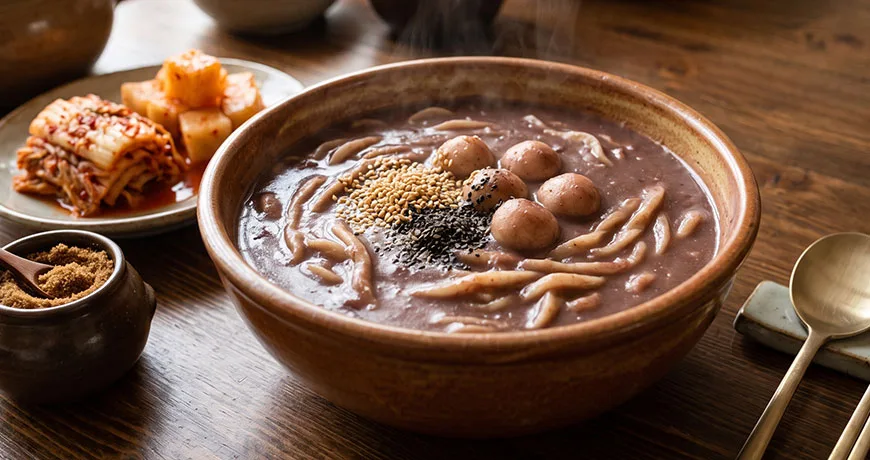
A hearty and comforting regional Korean noodle dish featuring chewy, knife-cut noodles swimming in a rich, velvety red bean broth. Enjoyed savory with salt or sweet with sugar according to personal preference.
⏱️ Prep: 15 mins | Cook: 60 mins | 🍳 Moderate | 🌿 Vegan | 🌾 High Fiber
Ingredients (2-3 servings)
- Main Ingredients: 2–3 portions fresh knife-cut noodles (kalguksu생면), 2 cups red beans (approx. 300g), 8–9 cups water (approx. 1.6–1.8L)
- Seasoning & Thickness: 1 tsp salt, 2–3 tbsp sugar (adjusted to taste), 2 tbsp glutinous rice flour (optional, for thickening)
Allergy Information
- Contains: Wheat (Fresh knife-cut noodles)
Equipment
- Pot, Blender (or Fine Sieve), Wooden Spatula
Cooking Instructions
- Initial Red Bean Boil & Discard: Wash the red beans thoroughly, place in a pot with water to cover, and bring to a boil. Boil vigorously for 3–5 minutes, then completely drain and discard the first boiling water to remove bitterness. Rinse the beans lightly.
- Simmering Red Beans: Return the rinsed red beans to the pot with 8–9 cups of fresh water. Simmer over medium-low heat for 40–50 minutes until the beans are soft enough to easily crush between your fingers.
- Blending into Smooth Broth: Transfer the cooked red beans along with their cooking liquid into a blender and blend until completely smooth to create the red bean broth. (For an extra smooth texture, pass through a fine sieve).
- Boiling the Broth: Pour the blended red bean broth back into a pot and bring to a simmer over medium heat. (If the broth is too thin, mix glutinous rice flour with a little water and stir it in to reach your desired consistency).
- Adding Noodles & Seasoning: Thoroughly shake off excess starch flour from the fresh knife-cut noodles. Add the noodles to the boiling red bean broth and cook for 5–6 minutes, stirring continuously with a spatula to prevent sticking to the bottom. Season with salt and sugar to taste, then ladle into bowls to serve.
💡 Cooking & Pairing Tips
- Essential First Boil Discard: Discarding the initial boil water is crucial as it removes saponins, which cause astringency and a bitter aftertaste, resulting in a clean, smooth, and deeply savory red bean flavor.
- Stirring and Dusting Starch: Red bean broth has high viscosity and scorches easily. Constantly sweep the bottom of the pot with a spatula while cooking, and be sure to shake off excess starch from the noodles so the broth doesn’t become overly thick or gummy.
- Perfect Food & Beverage Pairing: Pairs exceptionally well with tangy, refreshing dongchimi (radish water kimchi) or freshly made geotjeori (fresh kimchi), which cut through the rich density of the red bean broth. Enjoy with a warm cup of barley tea.
Storage Instructions
- The red bean broth can be prepared in advance and stored in an airtight container in the refrigerator for up to 2–3 days or frozen. However, noodles should be cooked directly in the broth right before serving, as they will absorb the liquid and turn mushy if stored after cooking.
Nutrition Facts (Estimated)
- Total Content : Approx. 900g (2-3 servings total)
- Calories : 1,050 kcal total (approx. 116 kcal per 100g / 350 kcal per 1 serving)
– Sodium : 850mg (43%)
– Total Carbohydrate : 210g (65%)
– Sugar : 24g (24%)
– Total Fat : 6g (9%)
– Trans Fat : 0g
– Saturated Fat : 1g (5%)
– Cholesterol : 0mg (0%)
– Protein : 38g (69%)
– Calcium : 140mg (14%)
Editor’s Review
1. Dense Savory Flavor Born from a Red Abyss
The moment the thick, rustic red bean broth touches the tip of the tongue, a heavy, affectionate nuttiness—reminiscent of a cozy warm room in a countryside home—overflows in the mouth. The velvety particles of finely ground red beans densely coat every strand of the chewy kalguksu noodles, delivering a luxurious richness of texture with every bite. When a subtle pinch of salt dramatically draws out the natural sweetness of the red beans, the palate willingly surrenders to the temptation of this thick, comforting umami. It is a delicacy that unfiltered reveals a ripe sensuality hidden behind a humble appearance.
2. The Aesthetics of Refined Density and Delicate Patience
Behind its simple visuals, Pat-kalguksu is the epitome of regional cuisine, concealing delicate refinement and precise heat control. Discarding the initial boiled water to drain away bitter saponins is an essential purification technique to isolate only the purest umami of the red beans. Thoroughly dusting off excess flour from the noodles prevents the broth from becoming overly gummy, while the patience required to constantly scrape the bottom of the pot with a spatula forms the core of achieving its ideal viscosity. It is a delightful smoothness crafted through fine mesh sieves and meticulously tuned time.
3. Gentle Solace Yielded from Shattered Hardness
The hard, uncompromising red beans endured the long heat of the flame, finally shedding their tough skins to be reborn into a soft sanctuary. The way the noodles intertwine with the red bean broth—which released its inner grains after enduring long trials—resembles the gentlest and most harmonious landscape reached by a life that has weathered harsh storms. With every swallow of the hot broth, even the chilled loneliness crouching deep within the heart melts warmly away. It is the hottest and most steadfast embrace of home, tenderly patting an exhausted soul at the turn of the seasons.