
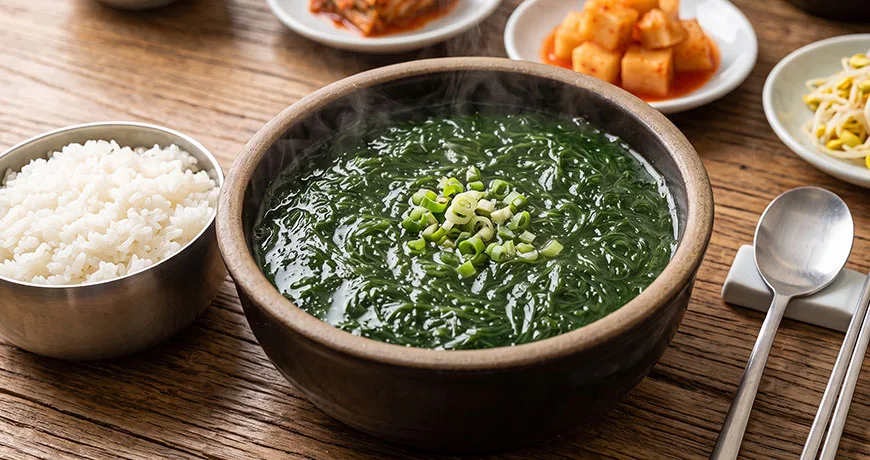
Maesaengitguk is the ultimate thermodynamic fluid dish, uniting the glycogen of bivalves (oysters) with a high-density hydrocolloid gel formed by the ultra-fine filamentous green algae, Maesaengi. Thinner than human hair, these multi-cellular algae strands trap water molecules forcefully, soaking up the broth via intense capillary action. This dense physical structure completely blocks the release of convective heat via steam evaporation, boasting an extreme heat retention rate where the soup can be boiling at 100°C without emitting a single wisp of steam. The Maesaengi, meticulously washed strand by strand by the hands of mudflat farmers enduring the freezing sea winds, is introduced at the very last moment alongside glycogen- and taurine-rich oysters. Turning off the heat just before the irreversible thermal contraction of the oyster proteins, and coating the surface with toasted sesame lipids, completes a biochemical essence of the sea that is refreshingly deep, yet dangerously hot on the palate.
⏱️ Total: 20 mins | Prep: 15 mins | Cook: 5 mins | 🍳 Difficulty: Moderate (Requires careful algae handling and thermodynamic temperature control) | 🌶️ Profile: Briny, Rich, Deeply Savory, and Deceptively Hot | 🍚 Focus: Thermodynamic Concealment, Capillary Action, & Bivalve Coagulation | 🍶 Pairing: Chilled, citrusy Yuja Dongdongju or clear Cheongju
Ingredients (2 servings)
- Ultra-fine Polysaccharide Matrix: 200g Fresh Maesaengi (Seaweed Fulvescens – washed with gentle agitation in light saltwater through a fine sieve)
- Succinic Acid & Glycogen Binder: 150g Fresh Oysters (rinsed in a 3% isotonic saltwater bath to purge impurities)
- Lipid Coating & Aromatic Catalyst: 1.5 tbsp Toasted Sesame Oil
- Hypertonic Umami Binder: 1 tbsp Soup Soy Sauce (Guk-ganjang), 0.5 tbsp minced garlic, coarse sea salt to taste
- Aqueous Umami Solvent: 600ml Clear Anchovy-Kelp Broth or purified water
Allergy Information Contains: Molluscan Shellfish (Oysters), Soy, Wheat (from soy sauce)
Equipment High Thermal Mass Pot or Ttukbaegi, Fine Sieve (for washing Maesaengi), Mixing Bowls
Cooking Instructions
- Osmotic Purging: Rinse the oysters in a 3% saltwater bath to prevent osmotic rupture. Place the Maesaengi in a fine sieve submerged in saltwater and agitate it very gently with your fingertips. This physical washing process is essential to remove mud without crushing the fragile cellular structure into mush.
- Lipid Coating & Extraction: Heat the sesame oil in a pot over medium heat. Add the cleaned oysters and minced garlic, sautéing lightly for 1 minute. The sesame lipids coat the oysters, preventing excessive glycogen loss and initiating thermal coagulation.
- Solvent Injection: Pour in the broth (or water) and turn the heat to high. The taurine and umami compounds released from the oysters dissolve into the solvent, creating a profoundly savory base.
- Viscoelastic Network Formation: Once the broth reaches a rolling boil, add the washed Maesaengi and season with soup soy sauce. The ultra-fine filamentous structure is highly susceptible to heat and will melt away if boiled too long. Heat strictly for only 2 to 3 minutes.
- Thermal Preservation: The moment the Maesaengi softens and the soup attempts to boil again, immediately kill the heat. Let the residual radiant energy finish the dish, establishing a deceptive fluid matrix that holds immense volcanic heat beneath a calm, steam-less surface.
💡 Professional Culinary Tips
- Mechanism of Thermodynamic Concealment: The old Korean adage, “Give Maesaengitguk to a son-in-law you secretly despise,” is grounded in absolute physics. The incredibly dense matrix of the ultra-fine algae fibers perfectly blocks surface evaporation. Because it doesn’t emit steam, it looks deceptively lukewarm, but the interior holds massive amounts of 100°C kinetic energy, requiring extreme caution when eating.
- The Physics of Gentle Washing: Aggressively kneading or rough-handling Maesaengi destroys its fibers. The artisan’s labor of floating the algae in cold saltwater and gently combing through it with the fingertips is not just a chore—it is a mandatory physical preservation technique to maintain the 3D filamentous structure responsible for its capillary absorption.
- Critical Coagulation of Bivalves: Both oysters and Maesaengi cannot withstand prolonged thermal hydrolysis. The absolute culinary rule for textural contrast here is to execute the boiling phase within a strict 3-minute critical window—just before the oysters contract into tough rubber and before the algae dissolves completely.
🍶 Gastronomic Pairing
- Biochemical Palate Cleansing: When the deceptively hot, heavy marine hydrocolloid and sesame lipids coat your esophagus, pair this dish with a chilled, citrus-infused Yuja (Yuzu) Dongdongju or traditional clear Cheongju. The natural fruit acids and micro-effervescence chemically slice through the lipid layer, violently absorbing the intense heat and cleanly resetting your sensory baseline in perfect temperature equilibrium.
Nutrition Facts (Estimated)
Total Content : Approx. 400g (1 serving)
Calories : 110 kcal
– Sodium : 720mg (Variable depending on natural oyster salinity and soy sauce)
– Total Carbohydrate : 6.0g
– Sugar : 1.0g
– Total Fat : 5.0g (Unsaturated sesame lipids)
– Saturated Fat : 0.5g
– Cholesterol : 40.0mg (From oysters)
– Protein : 10.0g
– Dietary Fiber : 4.0g
*Daily Values are based on a 2,000 calorie diet and standard Korean nutritional reference values.
**Nutritional values are calculated based on original ingredients; substitutions may alter specific macronutrients.
Origins and Food Culture of Seaweed Fulvescens Soup (Maesaengitguk)
1. Historical Lineage: Jeong Yak-jeon’s Jasanoebo and Pristine Southern Tidal Waters
- Chronicled in the landmark 1814 marine encyclopedia Jasanoebo by scholar Jeong Yak-jeon under the Hanja name Maesan (莓山), where it was praised: “Finer than silken thread, tangled like soft fleece, dark blue-green in color; when cooked into soup, it is meltingly tender, and its flavor is exceptionally sweet and fragrant.”
- Native to the pristine, non-turbid tidal waters of southern Jeollanam-do (Wando, Gangjin, and Jangheung), it was traditionally hand-gathered in the depths of winter (December through February), serving as an indispensable local restorative delicacy for fishing families before gaining nationwide fame as an elite winter wellness food.
2. The Culinary Science of Vapor-Trapping Latent Heat and Brief Simmering
- The physical structure of Capsosiphon fulvescens features microscopic, tightly interwoven filaments that form a dense colloidal mesh at the liquid surface; this layer traps evaporating steam, meaning the soup gives off virtually no visible vapor even while scalding hot underneath.
- Because prolonged boiling completely dissolves the delicate polysaccharide cell walls and causes the broth to thin out, the cooking process requires precise temperature control: the oysters and stock are brought to a boil first, and the seaweed is added at the very end for a brief simmer to preserve its vivid green hue, silky viscosity, and tender mouthfeel.
3. The Folklore of the “Unwelcome Son-in-Law” and Southern Comfort Hospitality
- Giving rise to the famous Korean folk adage, “When you dislike your son-in-law, serve him piping-hot Maesaengitguk”—humorously warning that because the soup appears completely cool due to the lack of visible steam, an unsuspecting diner who gulps down a large spoonful will severely scald the roof of their mouth.
- Concealing intense, scalding warmth beneath a tranquil surface, Maesaengitguk represents the subtle, understated warmth of Korean maternal hospitality, remaining an enduring monument of coastal slow food and winter gastro-culture.
The Silken Veil of Frost-Gathered Marine Emeralds and the Briny Sweetness of Winter Oysters: A Refined Portrait of Maesaengitguk
Maesaengitguk (Fine Seaweed Fulvescens Soup with Oysters) stands as the ethereal, restorative, and deceptively tranquil summit of Korea’s winter coastal (tang) gastronomy. Fine green seaweed (maesaengi—Capsosiphon fulvescens), whose hair-thin micro-filaments thrive only in the untamed, unpolluted mudflats and shallow tidal bays of southern coastal sanctuaries like Jangheung, Gangjin, and Wando, is harvested by hand in sub-zero winds and rinsed gently in fresh cold water. Briefly sautéed with plump, wild winter oysters in cold-pressed toasted sesame oil, it is swiftly simmered with pure water or anchovy stock over high heat and delicately balanced with aged soup soy sauce (guk-ganjang). Refusing the intrusion of fiery red chilies or heavy soybean pastes, this dish relies entirely on the pure chlorophyll vibrancy of delicate marine botanicals and the sweet, glycogen-dense succinic savor of winter oysters, achieving a state of profound culinary serenity.
Presented in a deep ceramic bowl, the gleaming, emerald-dark surface of Maesaengitguk presents an arresting illusion: with virtually no steam rising from its face, it seems cool and still. Yet, as a spoon parts the gossamer filaments, a rush of trapped, scalding heat is liberated alongside a magnificent aroma—the nutty perfume of roasted sesame mingling with the crisp, clean briny breath of wild coastal shores and tender oysters. Sinking onto the palate, the micro-threads require zero mechanical chewing; yielding without the slightest resistance, they glide across the tongue like warm liquid silk (hororok), bathing oral tissues in a dense, mineral-rich nectar. The poached oysters burst against the teeth with a plump, tender bounce, releasing streams of oceanic liquor and concentrated zinc-rich umami, while the transparent salinity of artisanal soy sauce grounds the finish in pure, lingering tranquility.
The enduring majesty of Maesaengitguk lies in its extreme environmental sensitivity—maesaengi cannot tolerate the slightest water contamination, serving as a pristine bio-indicator of ecological purity. Celebrated in Korean folklore through the witty proverb of the mother-in-law serving this deceptively steamless yet volcanic soup to an “unloved son-in-law” to teach him a humorous lesson, a steaming bowl of fine seaweed and oyster soup remains an irreplaceable monument of coastal resilience, winter wellness, and the deeply comforting ingenuity of southern Korean gastronomy.
Editor’s Review
1. A Dynamic Harmony of Frictionless Micro-Filament Glide, Plump Oyster Springiness, and Silky Lipid Lubrication
The textural landscape inside the bowl delivers an extraordinary, almost weightless experience of liquid velvet. The gossamer thallus filaments—each only tens of micrometers in diameter—bypass oral mastication entirely, offering a frictionless glide that cascades across the palate like liquid satin. This fluidity is punctuated by the tender, springy yield of plump winter oysters, which provide a delicate structural bounce without tough fibrousness. A trace emulsion of toasted sesame oil forms a protective, silky film across the lips, ensuring a continuous, non-fatiguing mouthfeel from the first sip to the last.
2. Sulfated Polysaccharide Vapor Entrapment (Thermal Insulation), Oyster Succinate-Glycogen Umami Synergism, and Chlorophyll Preservation Kinetics
Maesaengitguk represents an exacting study in marine polysaccharide colloid mechanics, thermodynamics, and food pigment chemistry. The cell walls and interstitial spaces of Capsosiphon fulvescens are dense with acidic sulfated polysaccharides and pectin-like polymers that swell in water to construct a tight, three-dimensional microscopic lattice. This dense filamentous network acts as a physical heat trap, severely suppressing surface convective evaporation and retaining steam within the liquid core; consequently, the soup appears steamless on top while maintaining an internal temperature exceeding 90°C. Concurrently, winter oysters supply concentrated succinic acid, sweet glycine, and cellular glycogen, which interact synergistically with the algal minerals and free glutamates from fermented soy sauce to exponentially stimulate human T1R1/T1R3 umami receptors. Cooking the soup through a brief, single flash-boil prevents the displacement of central magnesium ions from the chlorophyll porphyrin ring, halting the conversion of vibrant green chlorophyll into dull, brownish pheophytin and locking in its fresh marine terpene profile.
3. The Son-in-Law Folk Satire and the Living Winter Terroir of Korean Marine Botanical Gastronomy
Carrying the folklore of the “unloved son-in-law” whose hurried sips of the deceptively tranquil broth burned his tongue, Maesaengitguk bridges affectionate rural satire with serious nutritional therapy. Harnessing iron, calcium, and bioavailable folates from wild marine flora to warm and detoxify the human body through the harshest winter freeze, this pristine emerald bowl serves as an enduring sanctuary of ecological reverence, seasonal adaptation, and brilliant coastal craftsmanship.