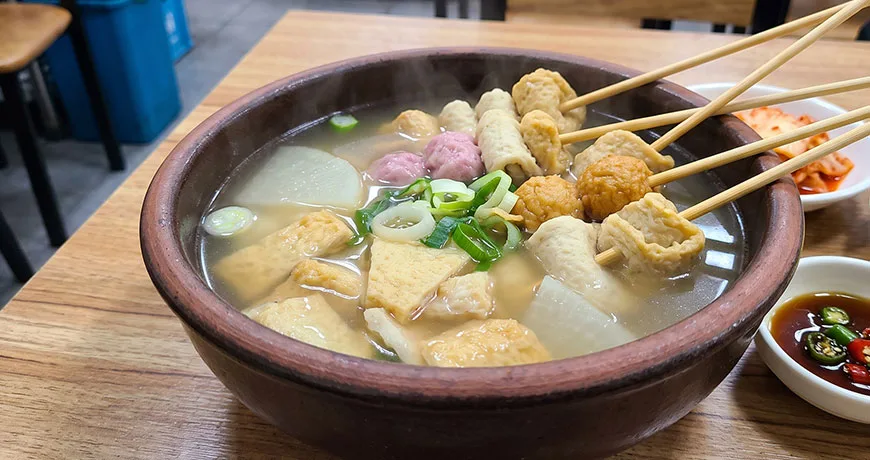
Eomukguk is a fluid-dynamic soup that leverages the thermal expansion of a myofibrillar protein matrix (surimi)—a paste made by aggressively kneading minced fish with salt. As the tough pectin of the radish gradually degrades in a cold-start anchovy broth, it releases cool, sweet reducing sugars. When the porous, hydrocolloid fishcakes are introduced, they act like biological sponges, forcefully absorbing this sweet, hypertonic cellular sap via capillary action. The artisan labor of carefully weaving the fishcakes into intricate S-folds on wooden skewers over a steaming pot is far more than an aesthetic choice; it is a precise physical engineering that restricts excessive thermal expansion, ensuring an explosive, bouncy mechanical snap upon mastication. The osmotic equilibrium achieved between the marine amino acids, the lipids from the fishcakes, and the hypertonic soy sauce creates the ultimate street gastronomy matrix designed to immediately restore kinetic heat to a cold body.
⏱️ Total: 25 mins | Prep: 10 mins | Cook: 15 mins | 🍳 Difficulty: Low (Requires surimi thermal expansion and pectin hydrolysis control) | 🌶️ Profile: Deeply Savory, Ocean-Sweet, and Comforting | 🍚 Focus: Thermal Expansion, Capillary Action, & Pectin Degradation | 🍶 Pairing: Chilled, mildly acidic traditional Yakju (clear rice wine) or Saeng-Makgeolli
Ingredients (2–3 servings)
- Surimi Gel Matrix: 300g Assorted and Rectangular Fishcakes (Eomuk – rinsed briefly with boiling water to remove surface lipids, then woven in S-folds onto wooden skewers)
- Pectin & Reducing Sugar Matrix: 200g Daikon Radish (cut into 3.5cm squares, 0.5cm thick)
- Aqueous Umami Solvent: 1.2L Anchovy-Kelp Broth
- Hypertonic Umami Binder: 1.5 tbsp Soup Soy Sauce, 1 tbsp Tsuyu (or Bonito-infused soy sauce), 0.5 tbsp minced garlic, coarse salt to taste
- Aromatic Catalyst: 1/2 stalk Green Onion (diagonally sliced), 1 handful Crown Daisy (Ssukgat – optional), a pinch of black pepper
Allergy Information Contains: Fish (Eomuk, Anchovy, Bonito), Soy, Wheat (from Soy Sauce/Tsuyu)
Equipment Wide, High Thermal Mass Pot, Long Wooden Skewers, Cutting Board, Knife, Slotted Spoon
Cooking Instructions
- Solvent & Pectin Hydrolysis: Place the sliced radish and the cold anchovy broth into a pot simultaneously and heat over high heat. Starting the radish in cold liquid ensures a slow, thorough thermal degradation of the cell walls, maximizing the extraction of its sweet reducing sugars and refreshing isothiocyanates into the solvent.
- Osmotic Binding: Once the broth reaches a rolling boil and the radish turns translucent, add the soup soy sauce, Tsuyu, and minced garlic to establish the baseline hypertonic concentration.
- Thermal Expansion & Capillary Absorption: Drop the carefully skewered fishcakes into the boiling broth. Immersed in the 100°C convective currents, the internal moisture of the surimi violently expands, swelling the gel matrix. These expanded microscopic pores act as vacuums, sucking the sweet radish broth into the fishcakes via capillary action.
- Critical Thermal Control: Do not over-boil the fishcakes. If left in the rolling boil for too long, the protein bonds will rupture, resulting in a soggy, formless mush. The exact moment the fishcakes puff up like balloons (about 3–4 minutes), reduce the heat to medium-low to lock in their elastic snap.
- Aromatic Finish: Scatter the sliced green onions and black pepper. Turn off the heat. Garnish with fresh crown daisy just before serving to introduce volatile herbal aromatics.
💡 Professional Culinary Tips
- Thermal Expansion of Surimi Proteins: Surimi gels expand to over 1.5 times their original volume when boiled. If introduced too early before the radish is fully softened, the prolonged heat will push the gel past its breaking point, destroying its signature elasticity. Controlling the thermodynamic timing by introducing the fishcakes only in the final stages is critical for a bouncy texture.
- The Physics of Skewering: The labor of folding the fishcake sheets onto skewers rather than just lazily chopping them is physically functional. The folded layers physically restrict the gel’s surface tension from expanding infinitely in the boiling water. This resistance creates a highly dense protein structure that produces a deeply satisfying, mechanical “snap” when bitten.
- Complex Umami Synergy: Using standard soup soy sauce alone yields a sharp, flat salinity. By cross-blending the inosinate of the anchovy broth with a splash of Tsuyu (bonito extract), you introduce heavily smoked amino acids. This biochemical synergy instantly replicates the complex, rounded depth of broth that has been simmering in a street vendor’s cast-iron cauldron all day.
🍶 Gastronomic Pairing
- Biochemical Palate Cleansing: When the heavy marine lipids of the fishcake and the salty Tsuyu broth coat your tongue, pair this dish with a chilled, traditional Yakju (Clear Rice Wine) or Saeng-Makgeolli. The natural lactic and citric acids produced during their cold fermentation slice through the lipid barrier perfectly, resetting your palate with crisp, effervescent precision.
Nutrition Facts (Estimated)
Total Content : Approx. 500g (1 serving)
Calories : 280 kcal – Sodium : 1,120mg (Variable depending on the fishcake and soy sauce brand)
– Total Carbohydrate : 30.0g
– Sugar : 6.0g
– Total Fat : 8.0g (Plant lipids from the fishcake frying process)
– Saturated Fat : 1.5g
– Cholesterol : 25.0mg
– Protein : 18.0g
– Dietary Fiber : 4.0g
*Daily Values are based on a 2,000 calorie diet and standard Korean nutritional reference values.
**Nutritional values are calculated based on original ingredients; substitutions may alter specific macronutrients.
Origins and Food Culture of Fishcake Soup (Eomukguk)
1. Port Heritage: From Early Modern Busan Fish Processing to Authentic Korean Tangban
- Tracing its roots back to the port city of Busan during the early modern era, where Japanese surimi processing techniques (kamaboko) were introduced around coastal hubs like Bupyeong Kkangtong Market and Yeongdo, evolving into Korea’s distinct deep-fried eomuk industry.
- Following the Korean War in the 1950s, affordable and protein-dense fishcakes served as an indispensable nutritional staple for refugees; as domestic cooks paired it with traditional anchovy-kelp stock, thick radishes, and Korean soy sauce, it transformed into a uniquely Korean domestic soup (tangban) celebrated nationwide.
2. The Culinary Science of Botanical Glucose Extraction and Umami Emulsification
- The hallmark of authentic preparation lies in simmering thick slabs of Korean white radish in anchovy stock over gentle heat well before adding the fishcakes, fully extracting natural glucose and fructose from the vegetable cells.
- This natural botanical sweetness rounds out the sharp salinity of the soy sauce without granulated sugar; as the fishcakes simmer, delicate lipids and amino acids leach into the broth, creating a light, glossy emulsification that imparts rich body while keeping the soup translucent and clean.
3. Street Pojangmacha Lore and the Nostalgia of the Winter Paper Cup
- Embodying the romantic street-food culture of Korean winters, where commuters and students huddle around steaming food carts (pojangmacha) to enjoy skewered fishcakes (kkochi-eomuk) and sip scalding, savory broth directly from disposable paper cups to chase away freezing winds.
- Remaining an indispensable staple on home breakfast tables, casual school snack spots alongside tteokbokki, and late-night gatherings, Eomukguk represents an enduring cultural emblem of warmth, resilience, and unpretentious everyday comfort across all generations of Korean culinary life.
The Plump Elasticity of Sea-Harvested Whitefish Surimi and the Caramelized Nectar of Slow-Simmered Radish: A Refined Portrait of Eomukguk
Eomukguk (Korean Fishcake Soup) stands as the dynamic, universally cherished, and heartwarming summit of Korea’s everyday comfort and casual street-food (tangban) gastronomy. Minced whitefish fillets—traditionally harvested from pristine coastal catches, seasoned with sea salt, bound with pure starch, and flash-fried into golden-brown cakes (eomuk or surimi)—are cut into bite-sized segments and submerged alongside thick batons of sweet Korean radish into a robust broth brewed from sun-dried anchovies and wild kelp. Gently seasoned with artisanal soy sauce to impart an amber glow and delicate savor, this dish simmers low until the fishcakes swell with ocean stock. Deliberately avoiding pungent chili pastes or heavy animal tallows, this soup marries the rich marine proteins and fried lipids of processed whitefish with the crisp, natural sugars of winter radishes into an extraordinarily soothing, effortlessly accessible culinary masterpiece.
Lifting a warm ceramic spoon overflowing with golden-amber broth, a plump, broth-saturated piece of fishcake, and a translucent slice of simmered radish awakens the senses immediately. The smoky, sea-kissed aroma of freshly simmered anchovy stock mingles with the toasted, nutty perfume of fried fishcakes and the sweet, caramelized breath of slowly melted radish. The first sip glides across the tongue with zero friction, coating the oral palate in a rounded, sweet-savory warmth that instantly banishes external chills. Sinking your teeth into the fishcake yields a gentle, buoyant elasticity—a delicate bounce that releases streams of concentrated fish jus and captured broth across the tastebuds. The radish yields effortlessly without mechanical pressure, bursting with cool, honeyed vegetal nectar that cleanly cuts through the fishcake’s richness, while crisp flecks of green scallions provide an invigorating finish that leaves the body comforted from the core outward.
The enduring majesty of Eomukguk lies in its historical transcendence—evolving from the bustling port factories of early 20th-century Busan into an indispensable source of affordable, high-density protein for displaced refugees during the Korean War, and eventually transforming into the ultimate street-cart staple across the nation. From the frosty canvas-draped food stalls (pojangmacha) of winter city corners to the intimate dinner tables of everyday homes, a steaming bowl of fishcake soup remains an irreplaceable monument of resilience, egalitarian hospitality, and profoundly reassuring gastronomic warmth.
Editor’s Review
1. A Dynamic Harmony of Swollen Surimi Buoyancy, Melting Radish Tenderness, and Velvety Sweet-Savory Broth Fluidity
The textural landscape inside the bowl delivers extraordinary structural comfort, agility, and effortless digestion. Simmered in boiling stock, the fishcake undergoes profound hydration, swelling into an ultra-tender, supple matrix that bounces gently against the teeth before dissolving smoothly without rubbery toughness. This pairs in striking harmony with the radish, whose softened fibrous tissues collapse like silk to flood the palate with stored vegetable moisture. The low-viscosity, soy-tinged broth acts as a continuous lubricant, permeating every spoonful and ensuring a cohesive, non-fatiguing mouthfeel from the first sip to the last.
2. Whitefish Actomyosin Hydrogel Swelling Dynamics, Fried Surface Lipid Hot-Water Leaching, and Radish Fructan Hydrolysis Kinetics
Eomukguk represents an exacting study in aquatic protein polymer physics, colloidal lipid dispersion, and thermal plant carbohydrate dynamics. The fishcake body consists of myofibrillar actomyosin networks extracted from salt-treated whitefish muscle, cross-linked into a thermally set 3D hydrogel. During simmering, this hydrogel absorbs the aqueous broth via osmotic capillary suction, creating its distinctively tender, juicy mouthfeel. Simultaneously, the residual frying lipids on the fishcake exterior are leached into the convective currents of the boiling broth, where water-soluble proteins from the anchovies and fishcakes act as amphiphilic emulsifiers, stabilizing microscopic lipid droplets into a light oil-in-water (O/W) emulsion that rounds out broth mouthfeel. Furthermore, prolonged thermal treatment triggers the hydrolysis of insoluble protopectin within the radish middle lamella into soluble pectin, while high-molecular fructans and glucans break down into free glucose and fructose, endowing the broth with a lingering, natural sweetness without artificial additives. The interaction between fishcake inosinate (IMP) and kelp-soybean glutamates triggers an exponential umami synergy across human T1R1/T1R3 receptors.
3. The Maritime Heritage of Busan Port and the Living Soul of Korean Casual Gastronomy
Originating from the industrial coastal kitchens of Busan, where surplus catches were transformed into accessible nourishment, Eomukguk captures the resilient adaptability of Korean culinary identity. Elevating humble fried fishcakes and storage root vegetables into an iconic restorative tonic through patient thermal balance and precise seasoning, this unpretentious classic serves as an enduring sanctuary of restorative wellness, nostalgic urban warmth, and brilliant culinary craftsmanship.