
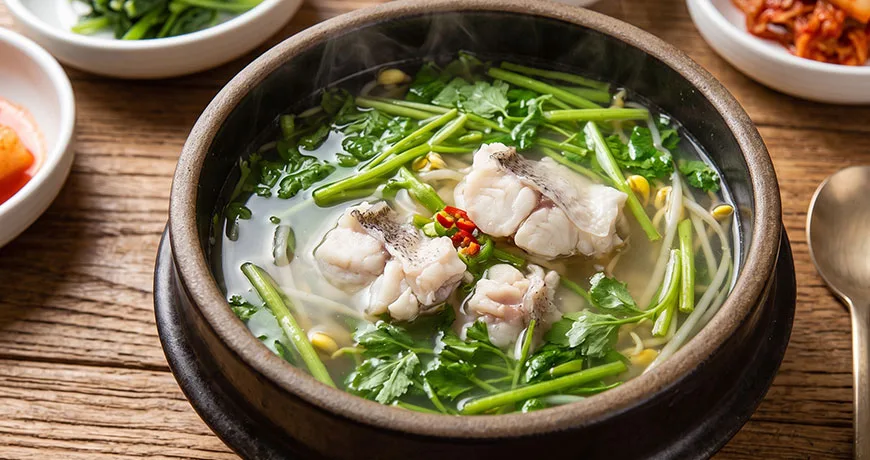
Bokguk is the absolute apex of molecular gastronomy—a life-or-death matrix where the lethal neurotoxin Tetrodotoxin (TTX) is strictly eliminated by licensed professionals, allowing the pure extraction of the pufferfish’s profound glycine and inosinate (IMP) reserves into a crystalline consommé. Unlike typical white fish, the myofibrillar structure of the pufferfish is extremely dense and highly cross-linked with collagen. This unique anatomy ensures that the flesh maintains a bouncy, viscoelastic chew even when subjected to boiling kinetic energy. After constructing a clear solvent base using radish reducing sugars and kelp glutamate, the pufferfish bones are thermally hydrolyzed to release their gelatinous umami. The dish is crowned with a massive amount of Water Dropwort (Minari), whose volatile terpenes chemically mask any trace of marine odor and provide a sharply refreshing finish. By entirely prohibiting minced garlic and soy sauce, this recipe preserves the pristine, elegant sweetness inherent to premium pufferfish.
- ⏱️ Total: 40 mins | Prep: 15 mins (Physical blood purging) | Cook: 25 mins
- 🍳 Difficulty: Extreme (Requires 100% professionally detoxified fish and critical convection control for clarity)
- 🌶️ Profile: Crystalline Clear, Elegantly Sweet, and Profoundly Clean Marine Umami
- 🍚 Focus: Blood Purging, Cranial Thermal Hydrolysis, & Terpene (Minari) Masking
Ingredients (3–4 servings)
- High-Density Amino Acid & Collagen Matrix: 1 whole Fresh Pufferfish (Bogeo – approx. 800g, cut into bone-in chunks. CRITICAL: Must be professionally gutted, detoxified, and certified safe, with eyes, brain, gills, and toxic organs 100% removed)
- Pectin & Aspartic Acid Matrix: 150g Daikon Radish (sliced into squares), 150g Soybean Sprouts
- Aqueous Umami Solvent: 1.5L Kelp Broth
- Aromatic & Terpene Catalyst: 2 large handfuls Water Dropwort (Minari), 1 white stalk of Green Onion (diagonally sliced), 1 Cheongyang green chili
- Ionized Sodium Binder: Coarse Sea Salt to taste (Soup Soy Sauce is strictly forbidden), 3 cloves Garlic (sliced, absolutely NOT minced)
Allergy Information Contains: Fish (Pufferfish)
Equipment Wide High Thermal Mass Pot, Fine Skimmer, Cutting Board, Knife
Cooking Instructions
- Blood Protein Purging: Even with a professionally prepped pufferfish, residual myoglobin and blood clots may remain inside the spinal cavities. Vigorously scrub the bone segments and skin under cold running water. Any remaining blood will thermally coagulate into a murky grey foam, ruining the crystalline purity of the broth.
- Cranial & Bone Hydrolysis: In a wide pot, bring the kelp broth, radish, and soybean sprouts to a boil. Introduce the pufferfish head and bone segments first. Reduce the heat to medium (90–95°C) and simmer for 15 minutes. This forcefully extracts the collagen and IMP from the skeletal structure into the clear solvent.
- Critical Myofibril Coagulation: Once the deep bone broth is established and the radish turns translucent, drop in the thick pufferfish meat chunks and sliced garlic. Simmer gently for 7–10 minutes. The dense myofibrils will contract, creating the signature bouncy, elastic texture unique to pufferfish.
- Protein Foam Clarification: Relentlessly use a fine mesh skimmer to remove any microscopic protein foam rising to the surface, maximizing the optical clarity of the consommé.
- Terpene Coating & Finish: Calibrate the final salinity strictly with sea salt. Just before killing the heat, heap the scallions, chili, and a massive mountain of Minari over the top. The radiant heat will activate the volatile plant terpenes, laying a crisp, forest-fresh aromatic seal over the marine broth.
💡 Professional Culinary Tips
- Biochemical Danger of Tetrodotoxin (TTX): The lethal neurotoxin found in pufferfish blocks sodium channels in the nervous system and is entirely heat-stable—meaning boiling it for hours will NOT destroy the toxin. Never attempt to butcher a whole, uncleaned pufferfish yourself. Only purchase fish that has been rigorously detoxified by a state-licensed expert.
- The Physics of Glycine and Viscoelasticity: What separates pufferfish from all other white fish is its explosive sweetness and rubber-like elasticity. The sweetness is derived from an unusually high concentration of the amino acid Glycine, while the elasticity comes from robust collagen networks in the muscle. To protect this elegant sweetness, abrasive allicin from minced garlic must be completely excluded.
- Molecular Role of Water Dropwort (Minari): The massive inclusion of Minari is not merely for aesthetics. The botanical terpenes act as a powerful palate cleanser, slicing through the collagen-rich broth. Historically, it is also a fundamental pairing in Korean gastronomy, as it was traditionally believed to help detoxify the body.
🍶 Gastronomic Pairing
- Biochemical Palate Cleansing: When the sticky, collagen-rich broth and the bouncy, sweet pufferfish flesh completely coat your oral mucosa, pair this masterwork with a highly refined, mineral-driven Chablis, or a hot cup of Hire-zake (sake infused with a roasted pufferfish fin). The tartaric acid of the wine or the warm lactic acid of the sake acts as a surgical solvent, cleanly slicing through the delicate lipid barrier on your tongue and geometrically amplifying the sophisticated marine umami of the very next spoonful.
Nutrition Facts (Estimated)
Total Content : Approx. 700g (1 serving, excluding bone weight)
Calories : 170 kcal (Excluding rice, ultra-low calorie, high-protein matrix)
– Sodium : 1,150mg (Dependent entirely on final sea salt calibration)
– Total Carbohydrate : 7.0g (Reducing sugars from radish and sprout polysaccharides)
– Sugar : 2.0g
– Total Fat : 1.0g (Extreme lean protein matrix)
– Saturated Fat : 0.2g
– Cholesterol : 60.0mg
– Protein : 33.0g (Highly bioavailable hydrated myofibrillar protein and collagen peptides)
– Dietary Fiber : 3.5g
*Daily Values are based on a 2,000 calorie diet and standard Korean nutritional reference values.
**Nutritional values are calculated based on original ingredients; substitutions may alter specific macronutrients.
Origins and Food Culture of Puffer Soup (Bokguk)
1. Historical Lineage: Neolithic Shell Mounds, Dongui Bogam, and the Lore of “Hadon” (河豚)
- Documented in ancient Chinese and Korean classical records under the Hanja name Hadon (河豚, literally “river pig” due to the grunting sounds made when inflating) or Gyu-eo (鯸鮧), pufferfish has sustained coastal peninsular populations for millennia, with bones excavated from prehistoric shell mounds (paechong) along the southern coast.
- In Heo Jun’s 1613 Joseon medical compendium Dongui Bogam, pufferfish was documented as “warm in nature, sweet, and highly toxic; it tonifies bodily deficiency (補虛), dispels dampness, cures waist and leg ailments, and treats hemorrhoids.” However, Heo Jun issued stern warnings that its liver, roe, and blood harbored fatal poisons requiring masterly cleaning. Jeong Yak-jeon’s 1814 Jasanoebo similarly praised the fish’s sweet, unctuous flesh as an incomparable delicacy while cautioning against its lethality, immortalizing pufferfish as a sublime gastronomic obsession enjoyed at the peril of one’s life.
2. Certified Detoxification and the Culinary Chemistry of “Minari and Vinegar”
- Because tetrodotoxin is a potent non-protein neurotoxin impervious to ordinary cooking heat, modern South Korea enacted strict statutory certification: only state-licensed Pufferfish Culinary Craftsmen (Bokeo Jori Gineungsa) are legally permitted to butcher and prepare the fish.
- Chefs practice absolute precision: purging all blood via flowing water and completely excising toxic organs before simmering the fillets with sweet radish and generous bunches of fresh water dropwort (minari), an herb celebrated in folk pharmacology for its natural antitoxic and chelating properties. Adding a dash of brewed vinegar tableside represents functional food science: the acetic acid induces isoelectric precipitation to tighten the fish fibers into their signature springy chew while neutralizing volatile amine odors.
3. Busan’s Haeundae Alleys, Southern Coastal Ports, and the Supreme Hangover Sovereign
- While historically restricted to elite banquet houses and Japanese-style restaurants, Bokguk exploded into everyday dining culture during the 1970s in Busan’s Haeundae district (pioneered by Geumsu Bokguk), which first introduced individual portions served in heat-retaining earthenware pots (ttukbaegi).
- Anchoring legendary culinary districts such as Haeundae and Jagalchi in Busan, Masan’s Odong-dong Pufferfish Street, and Tongyeong’s Seoho Market, Bokguk fostered a distinct regional dining ritual: boiling the fish in clear broth while tossing the cooked bean sprouts and minari tableside in spicy-sweet bibim sauce. Celebrated nationwide as the undisputed supreme sovereign of “White Hangover Relief” (baeksaek haejang), Puffer Soup remains an immortal monument to Korean maritime gastronomy, life-restoring clarity, and artisanal safety.
The Crystalline Elasticity of Apex Pufferfish Muscle, the Viscoelastic Sheen of Dermal Type I Collagen Gelatin, and the Piercing Respiration of Acetic Consommé: A Refined Portrait of Bokguk
Bokguk (Clear Puffer Soup, celebrated colloquially as Bokjiri) stands as the aristocratic, crystalline, and biologically astonishing summit of Korea’s marine clear-broth (cheongtang) gastronomy. Centered upon the tiger puffer (Takifugu rubripes or Chambok)—humanity’s most captivating culinary paradox, carrying lethal tetrodotoxin within its tissues—the dish begins with meticulous surgical butchery by certified master artisans. The toxic organs—principally the liver, ovaries, kidneys, and eyes—are excised with absolute precision, followed by intensive desanguination where the skeletal carcass and thick cranial bones are scrubbed beneath cold running spring water to purge every trace of vascular hemoglobin and mucosal biofilm. Anchored upon a generous bedrock of thinly sliced sweet winter radish and crisp soybean sprouts inside a heavy earthenware pot (ttukbaegi) or wide casserole, the vessel is flooded with a delicate dried kelp infusion alongside minced garlic and refined rice wine before being brought to a rapid, controlled simmer over convective heat. The moment the vegetable stock begins to bubble, the pristine puffer steaks and bone marrow are introduced, poaching gently between 85°C and 90°C while skimmers meticulously lift away rising froths and peripheral coagulants to preserve diamond clarity. Crowned at the final second with cubes of tender tofu, emerald ribbons of wild water parsley (minari), and scallions, the soup is seasoned with solar sea salt and finished tableside with a splash of natural brewed vinegar. Completely eschewing fiery pastes, heavy bean mashes, or cloying fats, Bokguk extracts the pure, unmasked amino acids and bone minerals of this ultra-lean fish (possessing less than 0.5% fat) through sheer thermodynamic minimalism, delivering an austere masterclass that purifies the palate and revives alcohol-inflamed tissues with radiant warmth.
Confronting the boiling earthenware vessel tableside as diamond-bright steam curls upward between vivid green ribbons of water parsley and ivory puffer segments, lifting a deep spoonful of the broth releases an immediate, deeply electrifying olfactory charge: the brisk, iodine-clean perfume of deep ocean waters mingles seamlessly with the honeyed vegetable sweetness of simmered winter radish, the sharp sulfurous warmth of fresh garlic, the crisp pine-fresh aroma of wild water parsley, and the brisk, mouth-watering lift of table vinegar. Taking the first sip delivers an unadorned revelation across the oral mucosa: completely devoid of greasy surface tension, the clarified amino acid broth floods the tongue with silk-like softness, gliding effortlessly down the esophagus to soothe fatigued tissues in an exhilarating wave of what Korean gastronomy reveres as siwonhan mat—the sensation of profound, soul-cleansing lightness and internal thermal relief. Sinking your teeth into the poached puffer meat reveals an extraordinary structural joy: forged to withstand hydrostatic pressures and body inflation, the dense white muscle fibers resist mastication with an energetic, springy bounce (taenggeul) before releasing concentrated streams of noble, sweet marine protein. In luxurious contrast, the descaled puffer skin supplies an unctuous, viscoelastic chew (jjondeuk) dense with bioavailable gelatin. Sliced winter radish yields with a succulent bite, framed by the brisk, auditory snap of briefly wilted water parsley and soybean sprouts. Dipping the succulent fish into piquant vinegar-chili paste (chogochujang) and steeping warm white rice into the diamond-bright broth alongside a crisp cube of aged radish kimchi transforms the meal into an unforgettable ritual of physical rejuvenation, coastal solace, and profound gastronomic catharsis.
The enduring majesty of Bokguk lies in its historical lineage—immortalized by the Song Dynasty poet Su Dongpo as a delicacy “worthy of dying for,” and codified in Heo Jun’s 17th-century medical compendium Dongui Bogam under the entry Hado-eo (河豚), where puffer is lauded as a sweet, warming restorative capable of replenishing depleted vital energy, unblocking meridian stagnation, and dispelling deep alcohol toxicity. Transcending its ancient reputation as a perilous gamble of the palate, Bokguk evolved along the windswept ports of the southern coast—crystallizing into legendary culinary enclaves across Busan’s Haeundae and Choryang, and Masan’s Odong-dong. Uniting apex marine protein with the crystalline clarity of winter vegetables and the invigorating lift of brewed vinegar, a steaming cauldron of clear puffer soup remains an irreplaceable monument of zero-waste marine stewardship, surgical craftsmanship, and brilliant Korean culinary artistry.
Editor’s Review
1. A Dynamic Harmony of High-Density Myofibrillar Spring, Viscoelastic Dermal Gelatin Elasticity, Crisp Botanical Turgor, and Frictionless Consommé Fluidity
The structural architecture inside the vessel delivers an extraordinary, high-contrast choreography between dense teleost myofibrillar bundles, heat-denatured dermal connective tissue sheets, hydrated plant cell walls, and an ultra-low-viscosity aqueous matrix. Because pufferfish possess an evolutionary adaptation for rapid abdominal distension, their skeletal muscle fibers exhibit an exceptionally high fascicular density; even under convective hydrothermal cooking, the meat resists structural disintegration, separating under mastication into dense, toothsome segments that push back against the teeth with a resilient bounce. Dynamic richness is supplied by the outer skin, which, stripped of its abrasive dermal prickles, undergoes hydrothermal gelatinization to yield an unctuous, viscoelastic chew (taenggeul-jjondeuk) that forms a lubricating film across the lips. Cushioning these textures, the braised winter radish collapses with a melting chew, framed by the brisk, auditory snap (ajak) of briefly wilted water parsley and soybean sprouts, ensuring an impeccably balanced, non-fatiguing mouthfeel from the first steaming sip to the last.
2. Actomyosin Syneresis Mitigation via Gentle Poaching (85–90°C), Dermal Type I Collagen Gelatinization, IMP-Glutamate-Asparagine Umami Synergy, and Acetic Acid TMA Salification with Hepatic Taurine Clearance Bokguk
represents an exacting study in tetraodontid fish muscle biochemistry, connective tissue thermodynamics, and volatile amine mitigation. Puffer white muscle is characterized by an ultra-low lipid profile (consistently between 0.1% and 0.5%) and high protein density; exposing the fillets to aggressive rolling boiling (>100°C) triggers rapid, irreversible hyper-contraction of myofibrillar actomyosin, causing extensive cellular moisture expulsion (syneresis) that leaves the fish unpleasantly tough and dry. Poaching the fish within a gentle convective window (85–90°C) over a bed of radish and sprouts preserves myofibrillar Water Holding Capacity (WHC), locking in cellular juices. Insoluble Type I collagen, densely woven within the cranial bones, fin bases, and thick skin, hydrolyzes into water-soluble gelatin polypeptides, endowing the clear broth with a subtle, lip-clinging dynamic viscosity. Broth savor is driven by an exponential three-way biochemical synergy: muscle-derived inosine monophosphate (5′-IMP) converges with natural free glutamates from the kelp and winter radish, alongside asparagine from the sprouts, triggering intense activation across human oral T1R1/T1R3 umami heterodimers. Crucially, the tableside addition of acetic acid (vinegar) lowers the broth’s pH, protonating volatile basic nitrogen compounds—principally trimethylamine (TMA)—into non-volatile ammonium acetate salts, thereby eliminating residual fishy off-notes while exciting salivary flow to heighten the clarity of the underlying marine umami. Biologically, dense concentrations of bioavailable taurine, glutathione, and methionine in puffer muscle accelerate hepatic alcohol dehydrogenase (ADH) and acetaldehyde dehydrogenase (ALDH) expression, swiftly neutralizing toxic metabolites to establish an immaculate, restorative recovery mechanism.
3. Joseon Dynastic Hadon Lore, Port-City Bokguk Alleys (Busan-Masan), and the Sovereign Apex of Marine Restorative Gastronomy
Subduing nature’s deadliest marine defense mechanism through surgical precision, disciplined thermal physics, and vegetable minimalism, Bokguk represents the pinnacle of daring culinary engineering in Korean gastronomic history. Evolving from coastal fishermen’s early morning restorative into an indispensable temple of sobriety for exhausted modern urbanites, this diamond-clear, vinegar-kissed classic captures the cold ocean’s untamed vitality in its purest, most noble form, standing as an enduring sanctuary of environmental authenticity, master craftsmanship, and brilliant Korean culinary artistry.