
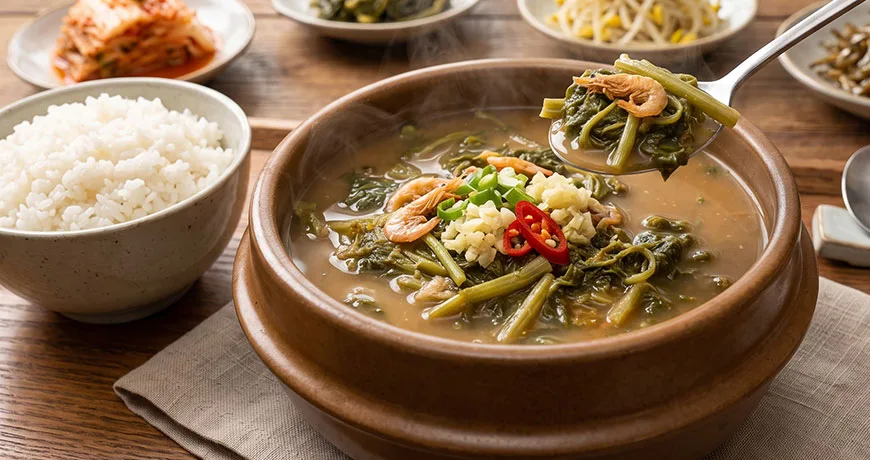
Aukguk is a biochemical soup that mandates rigorous mechanical maceration to obliterate the tough pectin networks of curled mallow (Auk). This physical trauma forcibly extracts bitter cellular alkaloids while simultaneously releasing mucopolysaccharides—a thick, viscous mucilage. When this mucilage interacts with the starchy colloidal suspension of rice water and fermented soybean paste (Doenjang) under kinetic heat, it exponentially increases the rheological viscosity of the broth, resulting in an unctuous, throat-coating mouthfeel. During autumn, as temperatures drop, curled mallow biologically defends itself from freezing by aggressively accumulating reducing sugars and free amino acids in its cells. When this hyper-sweetened autumnal matrix is combined with the water-soluble inosinate extracted from boiling dried shrimp, the resulting umami synergy is so profound that a famous Korean idiom states, “You lock your brushwood gate to eat autumn mallow in secret.”
⏱️ Total: 30 mins | Prep: 15 mins | Cook: 15 mins | 🍳 Difficulty: Moderate (Requires rigorous mechanical cellular rupture and mucilage extraction) | 🌶️ Profile: Earthy, Savory, Viscous, and Deeply Sweet | 🍚 Focus: Mechanical Maceration, Mucilage Emulsification, & Seasonal Biochemical Accumulation
Ingredients (2 servings)
- Polysaccharide & Fiber Matrix: 250g Autumn Curled Mallow (Auk – tough lower stems peeled, vigorously macerated with 0.5 tbsp coarse salt)
- Starch Colloidal Solvent: 1.2L Rice Water (Ssaltteumul – starchy water from the 3rd washing of white rice)
- Colloidal Umami Binder: 2.5 tbsp Doenjang (Korean fermented soybean paste), 0.5 tbsp Gochujang (Korean chili paste)
- Aqueous Amino Acid Matrix: 1 handful (approx. 15g) Dried Shrimp (head removed)
- Aromatic Catalyst: 1/2 stalk Green Onion (sliced diagonally), 1 tbsp minced garlic
- Starch Matrix: 2 bowls of warm, cooked white rice
Allergy Information Contains: Soy, Wheat (from Doenjang/Gochujang), Crustacean (Dried Shrimp)
Equipment High Thermal Mass Pot or Ttukbaegi, Mixing Bowls, Fine Mesh Strainer
Cooking Instructions
- Mechanical Maceration & Mucilage Extraction: Place the cleaned mallow in a large bowl, sprinkle with coarse salt, and knead it violently with your hands. This physical maceration crushes the cell walls, expelling the dark green, bitter cellular sap (alkaloids) and pulling the slimy mucilage to the surface. Rinse thoroughly in cold water 2–3 times to wash away the bitterness, squeeze tightly, and chop into 5cm lengths.
- Solvent Heating & Colloidal Suspension: Pour the starchy rice water into a pot and heat over high heat. Dissolve the Doenjang and Gochujang through a fine mesh strainer to create a stable, smooth colloidal suspension where starch granules encapsulate the fermented soy proteins.
- Aqueous Amino Acid Extraction: As the broth reaches a rolling boil, add the dried shrimp. Boil over medium heat for 3 minutes to forcibly extract the sweet glycine and savory inosinate from the chitin shells into the liquid solvent.
- Thermal Hydrolysis & Mucilage Integration: Add the macerated mallow and minced garlic. Cover and simmer over medium-low heat for at least 10 minutes. The residual pectin fully degrades under the sustained heat, and the plant’s viscous mucilage dissolves into the starchy broth, dramatically thickening its rheological texture into a velvety soup.
- Aromatic Finish: In the final minute, add the diagonally sliced green onions to bloom their volatile sulfur compounds. Remove from heat and serve immediately with warm rice.
💡 Professional Culinary Tips
- The Physics of Maceration: If curled mallow is boiled without being violently kneaded, it remains incredibly tough and tastes overwhelmingly grassy. The mechanical friction of rubbing it with salt utilizes osmotic pressure to force out the bitter alkaloids while deploying the plant’s internal mucilage (similar to okra). This viscous gel is the core fluid-dynamic element that gives Aukguk its signature, luxurious thickness.
- The Biochemistry of the “Locked Gate”: The idiom about eating autumn mallow secretly behind locked doors is rooted in plant physiology. To survive the approaching frost, autumn mallow converts its starches into high concentrations of reducing sugars and amino acids (a natural anti-freeze mechanism). This seasonal biochemical peak yields an unmatched, explosive sweetness and umami that summer mallow cannot replicate.
- Starch and Mucilage Synergy: The interaction between the amylopectin in the rice water and the mucopolysaccharides of the mallow creates a complex polysaccharide network in the boiling water. This not only perfectly masks the harsh salinity of the Doenjang but also acts as a thermal insulator, retaining the soup’s kinetic heat in the bowl long after it leaves the stove.
Nutrition Facts (Estimated)
Total Content : Approx. 500g (1 serving, excluding rice)
Calories : 115 kcal
– Sodium : 880mg (Variable based on residual salt from maceration and Doenjang)
– Total Carbohydrate : 16.0g
– Sugar : 3.0g
– Total Fat : 2.0g
– Saturated Fat : 0.5g
– Cholesterol : 35.0mg
– Protein : 9.0g
– Dietary Fiber : 6.5g
*Daily Values are based on a 2,000 calorie diet and standard Korean nutritional reference values.
**Nutritional values are calculated based on original ingredients; substitutions may alter specific macronutrients.
Origins and Food Culture of Curled Mallow Soup (Aukguk)
1. Classical Lineage: The “Master of All Vegetables” in Dongui Bogam and Bencao Gangmu
- Reorganizing ancient East Asian medical botanical lore, curled mallow (donggyu / 冬葵) was historically elevated as the foremost among the “Five Sacred Vegetables” (Ochae) in classic encyclopedias like the Bencao Gangmu and Heo Jun’s Dongui Bogam (1613).
- Celebrated in court and rural households alike for its cool, demulcent properties that clear visceral heat, stimulate smooth diuresis, and promote healthy postpartum lactation (choeyu), it served as an indispensable therapeutic soup long before it became an everyday domestic comfort staple.
2. The Culinary Science of Salt-Massaging and the Rice-Water/Dried Shrimp Triad
- The hallmark of authentic preparation lies in peeling tough fibrous outer skins from the stems and thoroughly kneading the leaves with coarse sea salt (barak-barak jumu-reugi) until a dark green, viscous sap is expelled and washed clean in cold water.
- This labor-intensive mechanical step leaches out bitter oxalic acid and raw astringent chlorophyll to unlock a meltingly soft, velvet texture upon boiling; cooking the prepared greens in starchy rice-washing water with dried baby shrimp mellows the salinity of the bean paste into a sweet, amber-toned elixir.
3. The “Closed Brushwood Gate” Lore and Autumn Culinary Traditions
- Because curled mallow plants synthesize elevated levels of natural sugars as temperatures drop to withstand early autumn frosts, it gave rise to the cherished Korean folk proverb: “Autumn mallow soup is so delicious you close the brushwood gate and eat it alone so your neighbors won’t find out.”
- Representing the comforting nostalgia of rural autumn harvests, the unmistakable aroma of mallow simmering with dried shrimp over a kitchen hearth remains an enduring cultural emblem of maternal warmth, rustic contentment, and Korean slow-food hospitality.
The Concentrated Autumn Nectar of Curled Mallow and the Savory Warmth of Rice-Starch Broth: A Refined Portrait of Aukguk
Aukguk (Curled Mallow Soybean Paste Soup with Dried Shrimp) stands as the rustic, deeply soothing, and physiologically restorative summit of Korea’s autumn leafy-green (tangban) gastronomy. Curled mallow (auk—Malva verticillata), having concentrated dense cellular sugars and mineral vitality under cool autumn breezes, has its fibrous stem skins peeled and its leaves vigorously bruised and kneaded by hand to eliminate excess vegetal astringency and harsh mucilage. Simmered in a starch-rich foundation of rice-washing water (tteumul), seasoned with deeply aged fermented soybean paste (doenjang), a subtle touch of sun-dried red chili paste (gochujang), and sweet dried glass shrimp (bori-saeu), this dish represents culinary minimalism at its most comforting. Honoring the centuries-old Korean proverb—”Autumn mallow soup is so delicious that one locks the wooden gate before savoring it alone”—it bypasses heavy animal tallows and aggressive spices, orchestrating the sweet, restorative nectar of seasonal greens and fermented legumes in absolute harmony.
Lifting a ceramic spoon brimming with golden-amber broth, tender emerald mallow leaves, and rosy dried shrimp awakens the senses with an immediate, comforting perfume: the deep, earthy bouquet of aged soybean paste mingles effortlessly with the sweet, ocean-kissed aroma of toasted dried shrimp and the clean, mineral breath of autumn greens. The first sip glides across the tongue in a velvety, starch-smoothed embrace, instantly comforting the digestive tract. Sinking your teeth into the cooked mallow reveals an extraordinarily tender, lubricated chew; yielding softly without the slightest stringiness, it releases a cascade of sweet, hydrating botanical juices. The thin, gossamer leaves melt effortlessly against the palate, while the crisp, chewy snap of whole dried shrimp introduces an engaging textural rhythm. The deep savor of the fermented soy paste and the gentle, clean prick of chili paste frame the entire bowl, leaving an enduring, heartwarming finish of pure culinary clarity.
The enduring majesty of Aukguk lies in its therapeutic functionalism—harnessing the cooling hydration, mucilaginous polysaccharides, calcium, and bioavailable vitamins of late-season mallow to soothe internal inflammation, promote digestion, and warm the body against incoming frosts. Celebrated in historic folk wisdom as a restorative tonic capable of “clearing even three years of accumulated indigestion,” a warm bowl of curled mallow soup prepared from a backyard harvest remains a timeless monument of agrarian wisdom, maternal tenderness, and comforting gastronomic integrity.
Editor’s Review
1. A Dynamic Harmony of Silken Mallow Dissolution, Toasted Shrimp Elasticity, and Starch-Emulsified Broth Body
The textural landscape inside the bowl delivers extraordinary comfort, lightness, and effortless digestion. The physical pre-kneading process tenderizes the mallow’s vascular networks, allowing the leafy fronds to soften into an ultra-smooth, lubricated glide that melts across the palate with zero resistance. Whole dried glass shrimp contribute a delicate, chitinous crunch and chewy resilience that punctuates the soft botanicals, while the microscopic suspension of suspended rice starches lends a round, velvety body to the broth, ensuring an impeccably balanced, non-fatiguing mouthfeel from the first sip to the last.
2. Cellular Bruising Pre-Treatment Hexanal Volatilization, Mucilage-Starch Colloid Stabilization, and Nucleotide Umami Synergism
Aukguk represents an exacting study in plant cellular histology, colloidal surface biophysics, and nucleotide-amino acid thermodynamics. Raw curled mallow leaves contain grassy aldehyde compounds, particularly hexanal, alongside viscous sap; vigorously kneading the salted leaves ruptures external plant cells, allowing volatile green odors and bitter glycosides to be leached and discarded in the rinsing water. The mallow’s natural mucilage (composed of complex acidic arabinogalactan and pectin polymers) binds with the dissolved amylose and amylopectin in the rice-washing water (tteumul), creating a stable, viscosity-enhancing colloidal hydrogel that coats the gastric lining. Concurrently, natural free glutamates generated by Bacillus subtilis during long-term soybean fermentation converge with sweet trimethylglycine (betaine) and nucleotide inosinate (IMP) concentrated within the dried shrimp, triggering an exponential synergy across oral umami receptors (T1R1/T1R3) that yields profound savory depth without artificial enhancers.
3. The Agrarian Heritage of ‘Gate-Locking Autumn Mallow’ and the Vanguard of Korean Hearthside Gastronomy
Prominently recorded across Joseon-era agricultural treatises as an indispensable autumn staple, Aukguk captures the deep ecological alignment of Korean foodways. By utilizing rice-washing starch water and house-fermented pastes to unlock the dense nutritional vitality of frost-ripened garden greens, this unassuming yet noble classic serves as an enduring sanctuary of restorative wellness, domestic warmth, and brilliant agrarian craftsmanship.