
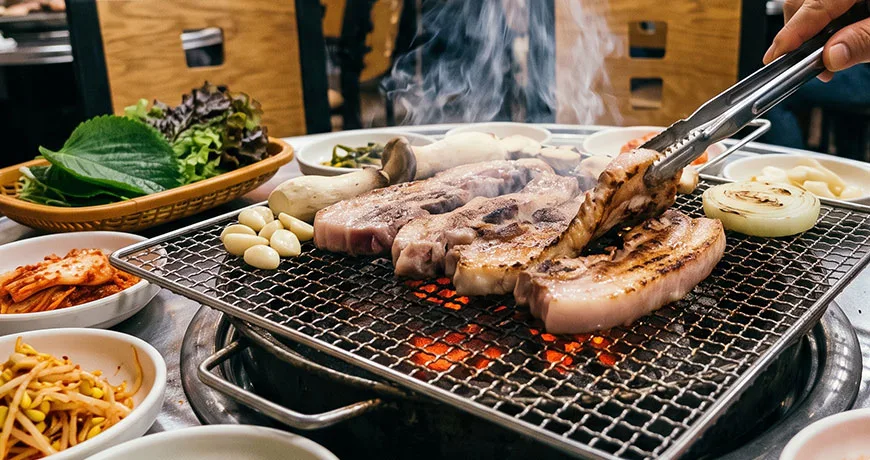
Sutbul-samgyeopsal is an exercise in extreme thermodynamic cooking. Unlike pan-frying, which relies on conduction, charcoal grilling utilizes the intense infrared radiant heat emitted by coals at over 700°C. This radiant energy flashes the surface moisture into steam instantly, inducing aggressive Maillard browning. Simultaneously, the thick subcutaneous pork fat renders and drips onto the white-hot coals. As the liquid lipids hit the heat, they undergo lipid pyrolysis, breaking down into a highly aromatic smoke aerosol. This smoke forcefully coats the meat, perfectly masking any pork odor and creating a phenomenally crispy exterior with an incredibly juicy, tender core.
⏱️ Total: 20 mins | Prep: 5 mins | Cook: 15 mins | 🍳 Difficulty: High (Requires strict radiant heat and flare-up control) | 🌶️ Profile: Intensely Smoky, Savory, and Crispy | 🍚 Focus: Infrared Radiant Heat, Lipid Pyrolysis, & Lipid Rendering
Ingredients (2–3 servings)
- Protein & Lipid Matrix: 600g thick-cut Pork Belly (2–3cm thick, essential for withstanding intense radiant heat)
- Osmotic Seasoning: 1 tbsp coarse sea salt (applied 10 minutes prior to grilling)
- Palate Cleansers: Lettuce, perilla leaves, Ssamjang (fermented soybean dip), raw garlic, green chilies
- Essential Equipment: Hardwood Charcoal (Baektan/White Charcoal), Heavy-duty Grill Grate
Allergy Information Contains: Pork
Equipment Charcoal Grill, Grill Grate, Long Tongs, Meat Scissors
Cooking Instructions
- Mechanical Prep & Osmosis: Score the surface of the thick pork belly at 1cm intervals. This mechanically increases the surface area for the Maillard reaction and prevents the muscle fibers from curling. Lightly salt the meat 10 minutes before cooking to initiate osmosis, then pat the drawn-out moisture dry.
- Radiant Heat Control: Ignite the charcoal and wait until the coals are covered in white ash (white-hot). Grilling over active, lapping flames will ruin the meat with soot. The core objective is to cook using pure, invisible infrared radiant heat.
- Lipid Rendering & Searing: Place the pork belly on the hot grate. The radiant heat immediately coagulates the surface proteins and begins rendering (liquefying) the dense subcutaneous fat, essentially frying the crust.
- Pyrolysis & Smoke Coating: As the rendered lard drips onto the coals, it vaporizes into an aromatic aerosol (lipid pyrolysis). Do not flip the meat constantly. Allow a deep, dark brown crust (bark) to form on one side so the smoke aerosols have time to adhere and chemically bond to the meat’s surface before flipping.
- Core Coagulation & Cutting: Once the exterior is 80% crisped, use scissors to cut the pork into thick, bite-sized pieces. Rotate the cut, pink cross-sections toward the heat for a final flash-sear to lock in the kinetic moisture, then serve immediately.
💡 Professional Culinary Tips
- Radiant vs. Convection Thermodynamics: A gas grill or oven uses convection (hot air) which slowly dries out the meat. Charcoal emits infrared electromagnetic waves. These waves bypass the air and strike the meat directly, driving massive thermal energy into the surface to create a crust in seconds while leaving the internal water molecules perfectly intact and juicy.
- The Biochemistry of “Fire Flavor”: The signature smoky flavor (Bul-mat) of charcoal grilling does not actually come from the wood itself. It is a direct result of the animal’s own rendered lipids hitting the high-heat carbon and chemically breaking down (pyrolysis). The resulting aromatic compounds ride the smoke back up to coat the meat.
- The Danger of Flare-ups (Flambé): A massive flare-up of flames when fat drips may look cinematic, but it is chemically destructive. Direct flames deposit uncombusted carbon (soot) and bitter, toxic polycyclic aromatic hydrocarbons on your food. If flames erupt, immediately move the meat to a cooler zone and let the radiant heat do the work.
Nutrition Facts (Estimated)
Total Content : Approx. 200g (1 serving, reflecting significant weight loss from lipid rendering)
Calories : 550 kcal
– Sodium : 450mg
– Total Carbohydrate : 0.0g
– Sugar : 0.0g
– Total Fat : 45.0g (Saturated fat significantly reduced vs. raw)
– Saturated Fat : 16.0g
– Cholesterol : 70.0mg
– Protein : 32.0g
– Dietary Fiber : 0.0g
*Daily Values are based on a 2,000 calorie diet and standard Korean nutritional reference values.
**Nutritional values are calculated based on original ingredients; substitutions may alter specific macronutrients.
Origins and Food Culture of Charcoal-Grilled Pork Belly
1. The Evolution from Tabletop Pan-Frying to Open-Flame Craft
- Evolving from the indoor pan-grilling boom of the 1970s and 1980s, the introduction of specialized charcoal hearths transformed everyday pork belly into a celebrated direct-fire barbecue experience.
- By searing the meat over natural charcoal, it subdued the pork’s natural oiliness while infusing it with deep aromatics, establishing a premium tier in Korean barbecue dining.
2. The Culinary Science of Radiant Heat and Natural Smoke Infusion
- The high radiant heat of lump charcoal instantly sears the outer meat fibers, sealing in succulent moisture while rendering excess grease through the grate.
- As dripping juices hit the hot coals, aromatic vapor rises to naturally smoke-kiss the meat, achieving the coveted balance of a lightly crisped crust and a juicy, flavorful interior.
3. The Centerpiece of Outdoor Leisure and Spirited Gatherings
- Whether around a campsite fire pit, a rustic suburban barbecue garden, or a bustling urban grill table, gathering around glowing charcoal embers captures the warm camaraderie of Korean social dining.
- Wrapped in fresh greens and shared over refreshing drinks, Sutbul Samgyeopsal remains an enduring national soul food that brings people together to unwind and celebrate daily life.
Stripping Away Excess Fat to Reveal Pure Savory Depth: The Searing Poetics of Charcoal and Pork Belly
The moment a thick slab of pork belly hits the searing grate, rendered droplets of clear fat strike the glowing embers below, sending up fine ribbons of aromatic smoke. Where a flat skillet bathes the meat in its own pooling grease, the charcoal grill operates on a philosophy of subtraction—letting excess fat drain away to distill the pork’s purest flavors. As the rising smoke wraps around the searing meat, an everyday cut is elevated into something remarkably refined and primal.
The first impression is the clean, unmistakable perfume of real hardwood smoke. Biting into a freshly charred morsel yields a delicate surface crunch from the fire-seared crust, followed immediately by the firm, satisfying chew of well-rendered fat and juicy lean meat. With the heavy grease purged by the coals, what emerges on the palate is not oily heaviness, but the concentrated, natural sweetness of the meat itself.
A single pinch of coarse salt is all it needs. The finish is strikingly clean, leaving no unctuous film behind. Relying on nothing more than prime pork, glowing embers, and attentive fire craft, charcoal-grilled pork belly proves that the simplest interaction between meat and open flame often yields the most compelling culinary reward.
Editor’s Review
1. Crisp Fire-Seared Crust, Clean Hardwood Aromatics, and a Firm, Rendered Snap
A complete departure from the greasy weight of standard skillet frying. The initial bite delivers a delicate, caramelized crackle, while the fat layers—purged of excess oil—offer a taut, springy chew rather than a soft, flabby texture. The subtle woodsmoke aroma pairs seamlessly with the pork’s natural savor, finishing clean without coating the palate.
2. Radiative Heat Searing Kinetics and Natural Smoke Aerosol Seasoning
Intense far-infrared radiation from the hardwood embers rapidly sears the surface proteins, locking internal juices firmly within the muscle fibers. Meanwhile, droplets of pork fat striking the 300°C coals undergo instant vaporization, rising as a fine aerosol that infuses the meat with genuine woodsmoke phenols and carbonyls that artificial seasonings simply cannot replicate.
3. The Craft of Flame Management and the Communal Vitality of the Live Hearth
Tending the grate to tame sudden flare-ups turns the meal into an active, engaging performance. Gathering around the rising smoke and timing each flip connects diners directly to the primal thrill of live-fire cooking, transforming a simple dinner into a shared, dynamic feast.