
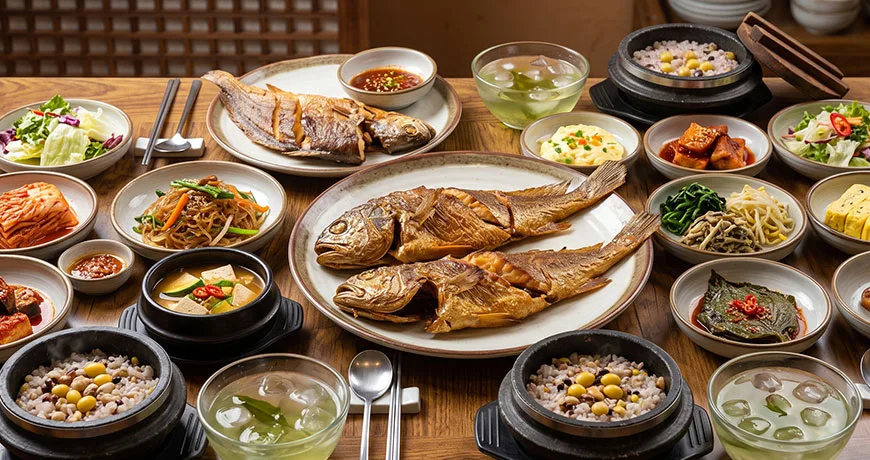
Borigulbi is a traditional fermented and dried seafood dish utilizing advanced biological moisture control and lipid anti-oxidation techniques. Semi-dried yellow croakers are buried in unhulled whole barley for months. The barley acts as a natural desiccant, absorbing excess moisture to prevent aerobic spoilage while physically blocking oxygen to prevent the fish oils from turning rancid. Before cooking, the highly desiccated fish is soaked in starchy rice water. The colloidal starch particles chemically adsorb and trap volatile trimethylamine (TMA) molecules, effectively neutralizing severe fishy odors while rehydrating the muscle fibers via osmosis. Finally, steaming the fish utilizes the latent heat of vaporization to gently denature the proteins without mechanical agitation, resulting in a remarkably dense, chewy texture heavily concentrated with umami amino acids.
⏱️ Total: 3.5 hrs (includes soaking) | Prep: 10 mins | Cook: 20 mins | 🍳 Difficulty: Moderate (Requires strict colloidal rehydration and latent heat steaming) | 🌶️ Profile: Deeply Savory, Chewy, and Umami-dense | 🍚 Focus: Colloidal Adsorption, Osmotic Rehydration, & Latent Heat Steaming
Ingredients (2 servings)
- Protein & Lipid Matrix: 2 Borigulbi (Dried Yellow Croaker aged in barley for at least 3 months)
- Colloidal Deodorizer & Osmotic Fluid: 1.5L thick Rice Water (water saved from the 2nd or 3rd washing of white rice, rich in suspended starches)
- Aromatic Masking Agents: 2 green scallion tops, 1 knob of ginger (sliced), 2 tbsp rice wine (Cheongju)
- Palate Cleanser Base: Ice-cold brewed Green Tea (for serving poured over rice)
Allergy Information Contains: Fish (Croaker)
Equipment Large Mixing Bowl, Steamer Pot, Kitchen Scissors
Cooking Instructions
- Mechanical Prep: Using sharp kitchen scissors, snip off the dorsal, tail, and pelvic fins. If any dried scales remain, gently scrape the surface with the back of a knife. This physically opens pathways for the osmotic fluid to penetrate the tough, desiccated skin.
- Colloidal Adsorption & Hydration (Soaking): Submerge the prepared fish completely in the thick rice water for 3 to 4 hours. The suspended amylose and amylopectin starch particles will chemically adsorb the sticky lipids and foul-smelling TMA molecules on the surface. Simultaneously, osmotic pressure slowly draws water into the dehydrated cellular matrix, swelling the shrunken muscle fibers back into a pliable state.
- Thermodynamic Prep: Fill the base of the steamer pot with water, adding the scallion tops, ginger slices, and rice wine. Bring the water to a rolling boil until it generates a steady stream of volatile steam.
- Steam Coagulation: Place the hydrated fish into the steamer basket, cover, and steam aggressively for 20 minutes. As the 100°C vapor condenses on the cooler surface of the fish, it releases a massive amount of latent heat. This thermodynamic energy rapidly penetrates to the core, thermo-coagulating the proteins into a tight, chewy matrix without leaching any flavor into a boiling liquid.
- Resting & Chemical Balancing: Turn off the heat and let the fish rest in the closed steamer for 5 minutes to stabilize the internal moisture. Debone the fish in large, meaty chunks. Serve alongside a bowl of rice soaked in ice-cold green tea.
💡 Professional Culinary Tips
- The Physics of Barley Aging: Whole, unhulled barley is a brilliant, natural microclimate controller. The rough husks are highly hygroscopic, physically absorbing excess moisture from the fish to prevent mold. They also pack tightly around the fish, displacing oxygen and preventing the intense concentrations of omega-3 fats from undergoing lipid oxidation (rancidity) over the months of aging.
- Biochemical Masking of Rice Water: Soaking highly desiccated, fermented fish in plain water is a mistake; the pungent trimethylamine (TMA) odors will simply diffuse into the water and reabsorb into the flesh. The macromolecular starch particles in rice water form a colloidal suspension that acts like a chemical sponge, physically trapping the TMA molecules in a gel-like matrix and stripping them away from the fish permanently.
- Palate Cleansing via Catechins: Borigulbi is intensely concentrated with dense animal fats and amino acids, which quickly fatigue the palate. Consuming it with ice-cold green tea serves two purposes: the cold temperature thermodynamically tightens the flesh in your mouth for extra chewiness, while the catechins and tannins in the green tea act as chemical astringents. They slice through the heavy lipid film on your tongue, completely resetting your taste receptors for the next bite.
Nutrition Facts (Estimated)
Total Content : Approx. 150g (1 serving, reflecting edible portion after drying and cooking)
Calories : 310 kcal
– Sodium : 720mg (Reflecting sodium reduction via osmotic soaking)
– Total Carbohydrate : 1.0g
– Sugar : 0.0g
– Total Fat : 14.0g (Highly concentrated Omega-3s)
– Saturated Fat : 4.0g
– Cholesterol : 130.0mg
– Protein : 42.0g
– Dietary Fiber : 0.0g
*Daily Values are based on a 2,000 calorie diet and standard Korean nutritional reference values.
**Nutritional values are calculated based on original ingredients; substitutions may alter specific macronutrients.
Origins and Food Culture of Barley-aged Dried Yellow Croaker (Borigulbi)
1. Heritage of Beopseongpo Coastal Breezes and Whole-Barley Storage
- Tracing back to the Goryeo Dynasty when exiled nobleman Yi Ja-gyeom sent dried yellow croaker to the royal court with the name Gulbi (“unyielding integrity”), the port of Beopseongpo in Yeonggwang became the historic epicenter of Korea’s dried croaker heritage.
- In the era before refrigeration, coastal ancestors invented an ingenious preservation method: burying firm, sea-wind-dried croakers in layers of whole barley (tongbori) inside earthen jars to keep them fresh and richly aged through scorching summers.
2. The Culinary Science of Rice-Water Soaking and Gentle Steaming
- The hallmark of authentic preparation lies in submerging the aged, rock-hard fish in rice-washing water (ssal-tteum-mul), allowing delicate starch molecules to soften tough muscle fibers and draw out excess salt while neutralizing residual fishiness.
- Gently steaming the rehydrated fish melts internal lipids without drying the meat, achieving the signature kkudeok-kkudeok texture—a dense, delightfully chewy, and supple bite unlike any standard grilled fish.
3. Chilled Green Tea Rice Bowls and the Pinnacle of “Rice Thieves”
- Hand-shredded into tender golden flakes, the steamed fish is traditionally enjoyed draped over a spoonful of cold rice steeped in iced green tea water (nokcha-mul) or dipped in aged gochujang.
- The crisp, clean astringency of the chilled green tea cuts through the concentrated richness of the aged croaker, creating an iconic gastronomic synergy that makes Borigulbi an enduring crown jewel of traditional Korean fine-dining banquets.
The Concentrated Weight of Maritime Winds and Barley Earthenware: A Refined Portrait of Borigulbi
Borigulbi (Barley-Aged Dried Yellow Croaker) stands as a profound, patience-tested pinnacle of traditional Korean seafood preservation and gastronomy. Fresh yellow croaker is salted with aged sea salt, dried in the brisk maritime winds of the West Sea until firm, and layered inside breathable earthenware jars filled with unhusked whole barley grains to age over multiple seasons. Far from simple dehydration, burying the dried fish in grain creates a natural metabolic exchange: the porous barley hulls absorb oxidizing fish oils while imparting a subtle, nutty grain aroma, transforming an everyday catch into an aristocratic, amber-hued delicacy.
After its long slumber in barley, the cured croaker is steeped in starch-rich rice-washing water to temper excess salinity and neutralize sharp marine odors, then gently steamed and hand-shredded along its muscular flaking lines. The first encounter fills the senses with a deeply savory, fermented perfume enriched by natural sesame-like nuttiness. Sinking your teeth into a thick, amber-toned morsel introduces the signature kkudeok-kkudeok texture—a dense, delightfully springy chew found nowhere else in seafood cuisine. Each bite releases a concentrated surge of umami-rich inosinates and mature lipids, balanced by the mellow warmth of grain-fermented complexity.
The true magic of Borigulbi is unlocked when paired with a chilled bowl of white rice steeped in icy green tea or barley water. Placing a savory piece of shredded croaker and a dab of red chili paste over a spoonful of ice-cold, tea-soaked rice creates an exhilarating contrast: the brisk, tannic tea washes away heavy fish lipids while firming the fish’s dense elasticity, instantly reviving fatigued appetites during the sultry summer months. A celebratory feast of barley-aged croaker proves that traditional preservation craft can elevate humble coastal bounty into an unforgettable, deeply grounding gastronomic journey.
Editor’s Review
1. A Dense, Springy Elasticity, Amber Translucency, and the Deep, Fermented Umami of Barley Aging
The texture of barley-aged croaker offers a dense, chewy resilience that sets it far apart from tender poached or grilled fish. As you chew through the golden flesh, the concentrated muscle fibers release deep savory notes of mature inosinates and nutty lipids without greasy heaviness. Paired against chilled green tea rice, the brisk astringency of the cold broth cuts cleanly through the fish’s natural richness, orchestrating a refreshing and endlessly appetizing cadence.
2. Porous Whole-Barley Lipid Adsorption Dynamics, Rice-Water Colloid Deodorization, and Controlled Steam Rehydration
Borigulbi represents an exacting study in seafood lipid management and starch colloid mechanics. The unhusked barley grains physically absorb weeping surface lipids, preventing rancid oxidative degradation while maintaining stable humidity in the earthenware vessel. Subsequent soaking in starchy rice-washing water leverages suspended amylase and starch colloids to physically adsorb volatile amines (trimethylamine), stripping away off-flavors while osmotic rehydration gently softens the dense actomyosin matrix for uniform steam cooking.
3. The Coastal Wind-Curing Heritage of Beopseongpo and the Sustaining Wisdom of Korean Hearthside Hospitality
Born along the breezy shores of Beopseongpo in Yeonggwang, Borigulbi honors a centuries-old preservation heritage devised long before modern refrigeration. Hand-tearing each golden, steamed fish to share around the table reflects a heartfelt tradition of generous hospitality and restorative seasonal eating, offering diners a deeply restorative haven of wholesome craftsmanship, heritage, and pure culinary satisfaction.